
The Defixio: Chapter VIII
Literary Historical Fiction


Chapter Navigation:
Chapter VIII
The next morning, Zoilos did not linger in the wards, nor present himself in the parade ground. He went directly to the record strong room behind the principia, careful to avoid any pretext of routine. The corridor was already hot, the slabs underfoot sweating a mineral haze. The air inside the archive pulsed with resin from the hypocaust, and the curtain at the threshold was damp from the night’s humidity. He waited. Two minutes, four, six; measured by his own pulse, until he was certain no one else would pass.
The interior was unlit. Zoilos let his eyes adjust, cataloguing the layout from the last visit. The shelves remained as before, but the bark scrolls had shifted. One row was missing; a set of tablets marked for imperial audit had been removed, leaving a light rectangle in the dust. The inventory at the rear, the quarterlies, seemed untouched. He went for those.
Zoilos selected the scrolls he required. The records of Senilis’s command: years 361 through 364, with each quarter bracketed by delivery receipts and waste manifests. He opened them flat, running his finger down the margins as if reading the braille of bureaucracy. At first, the numbers fell into expected ranges—rations, bandages, cheap olive oil. Then a jump. The spring of 363: a shipment of hydraulic lime, five times the usual order, sourced from Tarraco in Hispania and rerouted through Londinium, then up the Wall by oxcart. The line in the log said, “For repairs to south bathhouse wall.” The sum was so out of scale that Zoilos read it twice, then traced it backward. No mention in the previous quarter, no follow-up in the next. Only the one line, circled and stamped.
He wrote it on his own tablet, copying the entry with as much precision as he could muster.
Zoilos went to the south wall of the fort, walking the perimeter as if inspecting for a breach. The bathhouse was a low rectangle built of local stone, roofed with clay tile, and tucked against the embankment. The south face was ancient, patched in three shades of mortar; the most recent was a dun color, applied in streaks that ran down from the eaves. He bent and scraped a sample from the seam, rolling it in his fingers. The mortar was old, crumbly, never wetted by rain. No repairs had been made in at least a decade, perhaps longer.
As he straightened from the mortar seam, something at the edge of his peripheral vision resolved into a figure. On the far side of the parade ground, in the shade of the principia’s west wall, a man stood watching the traffic along the via principalis. Short, dark, arms loose at his sides, the stance too evenly weighted for a tradesman taking a rest. He wore civilian brown, no insignia. When he shifted his weight to cross a patch of sun, Zoilos caught the gait: deliberate, with a small drag at the right foot, as if an old injury had set badly and healed around the bone. The man did not return Zoilos’s look. He was watching something else. Zoilos filed the observation under nothing in particular and turned for the bathhouse door.
He ducked into the bathhouse, holding his breath against the sour smell of ammonia and lanolin. The anteroom was empty. A sweep of dust on the bench, a crust of soap scum at the lip of the cold pool. No sign of recent construction. No barrels or tools. The hypocaust vents had silted shut.
The cold hit him after three steps. The bathhouse had not been heated in weeks, perhaps months, and the stone held the chill the way the archive held its heat. Water had pooled in the shallow channel along the north wall and gone stagnant, its surface carrying a film of green that caught no light. The plaster above the cold pool had cracked and shed in sheets, exposing the rubble core beneath. No one had swept the fragments. They lay where they had fallen, a scatter of white dust and plaster flakes that crunched under his sandals like frost.
He crouched and examined the floor. Not a single flagstone was out of place, but at the far end, where the light from the slit windows barely reached, he saw the white tinge of lime dust in the creases. He knelt, brushed the powder with a cloth, and sniffed. The tang was familiar. He had smelled the same in Block IV, at the line where child and lime met the earth.
Zoilos made a note. He left through the rear exit and circled back to the records office.
Crossing the parade ground, he passed a laundry woman from the praetorium — a local slave with a basket of folded linens braced against her hip, bare feet noiseless on the packed earth. She did not look up. Zoilos’s eye caught her, registered the silhouette and the institutional uniform, and released her. The detail joined the day’s other peripheral data, filed below the threshold of relevance.
Solinus, the clerk, was not at his desk in the records office. The surface of the standing desk was empty, the reed pen cleaned and laid across the inkwell at perfect right angles. Zoilos glanced left and right, then stepped to the ledger shelf. His heart began to pound. He found the quarterly for the year in question, then the secondary copy beneath it. The latter, labeled in a different hand, was a running log of requisitions, less official but more truthful. He scanned the page for the bathhouse repairs. The line was there, but the annotation read: “For urgent use. Vaulted by command.”
Zoilos snapped the wax tablet shut and replaced it.
Before he turned to leave, his eye caught on the current-quarter day log, open on its stand at the edge of Solinus’s desk. The entries for the past week were recorded in the clerk’s small, fever-careful hand. Zoilos scanned for his own name and found two of his recent submissions: a water-ration adjustment, a fly-paper requisition. The third, a routine report he had filed two mornings past on the granary’s main corridor, was not there. He had noted a persistent damp at the threshold and the infestation of grain beetle in the south silo, the kind of observation a physician files without expectation of reply. The line where it should have sat was clean, the wax smoothed and re-scored. He did not linger on the absence. He closed the log exactly as he had found it and stepped back from the desk.
He lingered, considering the perimeter of the room, the silent curtain that trapped the heat.

Zoilos returned to the valetudinarium just before the bell. Barsamias was changing the bandage on a patient with a groin abscess. He did not look up. Zoilos passed through the ward, then into his quarters, where the windowless dark was a comfort.
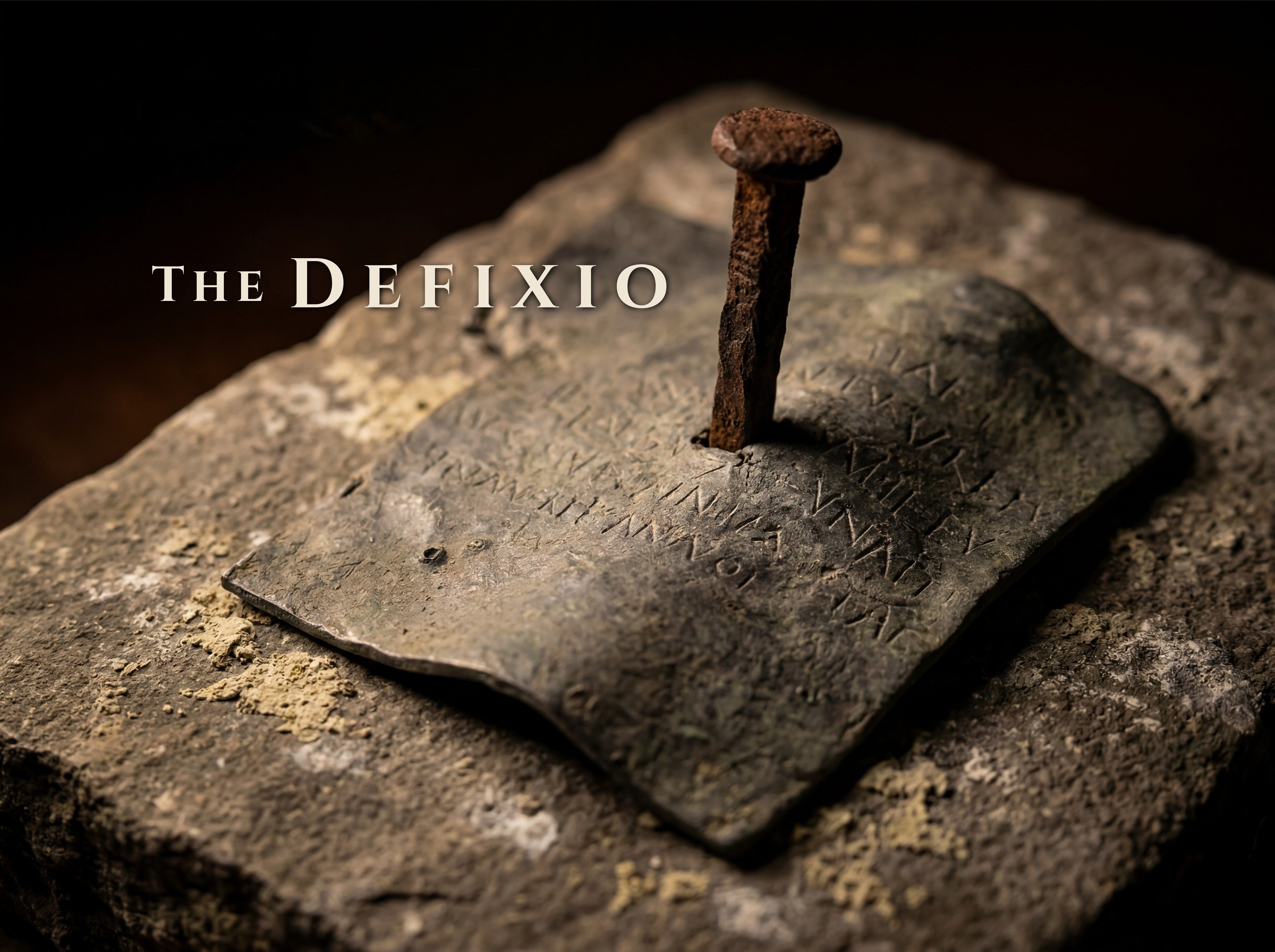
In his quarters, before he set the day’s findings on the worktable, he opened his medical kit and drew out the lead cylinder defixio. It still lay where he had stowed it after the autopsy, wrapped in linen, the bent nail intact. He had not burned it. He had not sent it south. He set it under the lamp and tried again, as he had twice in the intervening weeks, to read the script. The letters refused him as before; cut backward into the metal, mirror-reversed, in a hand he had never been taught. He owned no surface polished enough to right them. He rewrapped the cylinder, returned it to its place, and marked the failure in his ledger.
He sharpened the stylus, then opened his copy of Galen’s On the Natural Faculties. It was a battered volume, the binding cracked, the pages pressed flat from repeated readings. Between every fifth page, Zoilos had folded his own slips of annotation: observations in code, notes on the pattern of illness, sketches of the fort’s channels and flow. In Pergamon, this had been his most prized possession. Here, it served a double purpose: an archive, and a hiding place for notes he dared not keep in the open.
He thumbed to the middle of the text, where he had last concealed a tablet. There was a foreign object there—a resistance, thin but present. He eased the page apart, and something pale fell to the surface of the desk.
Something pale slid from between the pages and landed on the desk without sound. It was so light that the air from the book’s closing almost carried it off the edge. Zoilos’s hand moved to catch it before his mind had identified what it was. The shape was flat, fragile, the colour of old linen. His fingers hovered over it without touching, the way they hovered over a wound before the first incision.
A flower, pressed and perfectly preserved. White petals, tips tinged a colorless yellow, the stem as fine as spun hair. Zoilos stared, at first not understanding. He sniffed it. The scent was faint, but familiar, impossible in this latitude: Mediterranean rockrose, a species native to the shores east of Ephesus.
His thumb and index finger trembled as he picked it up. He examined the matrix: pressed perfectly flat, dried by hands that knew how to avoid bruising. The flower had not been in the book the day before. He was certain. He checked his notes: none disturbed, but the page with the ciphered annotation on the cedar fiber had been ever so slightly uncreased. Someone had read the notes, replaced them, and left the flower as taunting proof.
His breath went shallow, each inhalation controlled to prevent the faintest sound. He catalogued the scenario, replaying every moment of the last twenty-four hours. The only possible entries into the room: Barsamias, the Batavian janitor, the cleaning slave with a fused left knee, or someone with the keys and the knowledge to use them. None could identify a Mediterranean flower on sight, nor know which page of On the Natural Faculties to use for such a message.
His hands were steady. He checked them, held them out flat, and watched for the tremor he expected. It was not there. The steadiness was itself a symptom: the body’s way of compensating for a threat it could not locate. His skin had gone cold at the forearms, the fine hairs standing. The room, which he had entered as a sanctuary, had become a space that had been occupied by someone else and returned to him with the shape of his privacy still dented, like a pillow that holds the impression of a head that is no longer there.
He put the book down and turned the flower in his hand. The preservation was professional—better than his own attempts at herbarium. Whoever had done this was not only learned, but practiced. The flower was a message. He did not need to translate it.
Zoilos pressed the flower to his nose again, closed his eyes, and let the pattern resolve. He felt the sweat rise under his tunic, the oil on his fingertips catching the light as he rolled the specimen. His mind raced.
He opened his notes to the page with the cedar fiber. He compared the color, the texture, the faint smell. The flower and the fiber could have come from the same country, if not the same garden.
He set both on the desk, side by side, then wrote in the margin: “Contagion. Localized. Diagnosis: external intervention, by unknown hand.”
He snapped the book shut, then slid it under his pillow. He rose, washed his hands in the basin, and watched the water swirl before it drained.
He felt eyes on him, even in the dark.
Outside the window, the fort was quiet. Across the via principalis, the lamp in Terentianus’s office burned steadily, a pinprick of gold through the haze. Zoilos watched it for a full minute, never blinking, until the light went out.
He returned to his cot. He lay down, boots still on, and let the air cool the sweat from his skin.

In the morning, the flower was still there, uncrushed, on the surface of the desk.
He treated it as evidence. He set a fresh blade on the desk, sliced a sliver from the petal, then pressed it between two strips of parchment. The color did not bleed; the oils did not transfer. He took a length of thread, wound it tight around the stem, and watched as the tension failed to break the fibers. The preservation was better than anything achievable with the tools in this fort. The conclusion was obvious: it had arrived recently, perhaps with the diplomatic pouch or a private courier. Or it had been carried on a body already acclimated to the climate—a living, breathing message.
He set the flower beside the cedar fiber, aligning them with the obsessive care he reserved for bone fragments at a forensic autopsy. He made a note: “Concordance. Origin: foreign. Vector: human.”
He thought about the day’s events: the absence of new fever cases in the ward, the way Barsamias had hovered at the margins of every conversation, the way Terentianus’s office light had flickered during the night, always in response to movement at the north gate. He saw the pattern emerging, even if the specifics were beyond reach.
His rage, when it came, was clean. It did not spasm through his body or rattle his breath. Instead, it sharpened every motion. He wrote in a finer hand. He capped his ink jar with force but without a drop spilled. He put every object back exactly where he found it, then straightened the line of his cot, folded his blanket into a triangle, and placed his boots at the foot, heels aligned.
He did not speak to Barsamias that morning. He did not report to the principia, nor sign the log at the entrance to the wards. Instead, he compiled a new record: an inventory of every item in his room, each page in On the Natural Faculties , every margin annotated with the code known only to himself and, now, his adversary.
I was worried about Zoilos before this chapter, but now I'm really afraid for him.