
A Procession of Ashes: PREVIEW
A Medieval Horror Novella

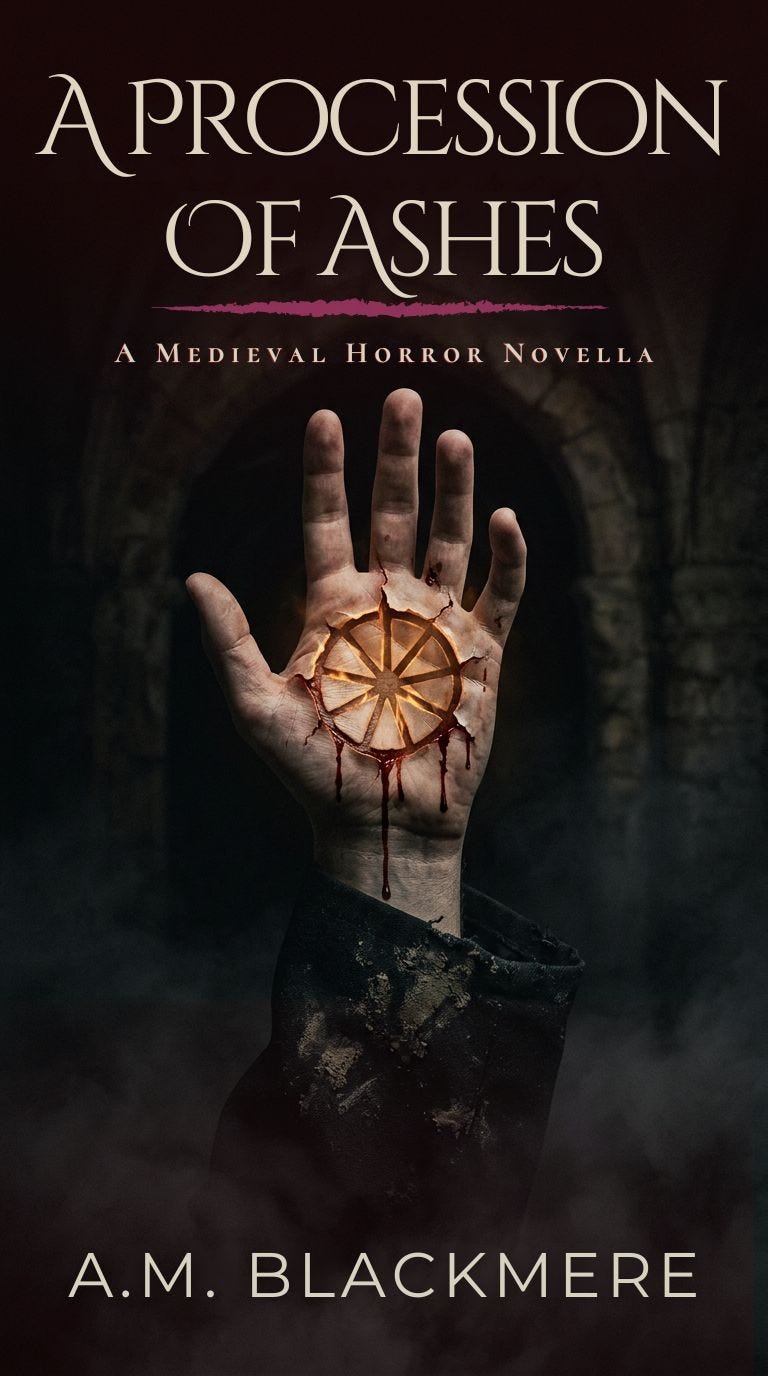
Piacenza, Italy. The Year of Our Lord, 1349.
Father Matteo has shepherded a dying flock through plague and lime, but nothing in his missals prepared him for the Brotherhood of Broken Flesh—a ragged procession of flagellants who turn suffering into scripture.
When their leader, Fra Aureliano, raises a living Psalm and the faithful begin to speak its geometry in flesh, devotion itself takes on a fevered life.
Beside him stands Tommaso Bellini, an empiric physician tracing the hidden pattern between faith and decay. Together they seek to silence a Psalm that should never have been sung—and learn that belief, once awakened, does not easily sleep again.
If you loved The Name of the Rose or Between Two Fires, this slow-burning, lingering medieval horror will feel like coming home to a darker age.
Chapter 1 Preview:
The day the Brotherhood of Broken Flesh entered Piacenza, a thin, cold rain fell through the late-September air, mingling with the copper-sweet stench of blood and the sour bite of decay rising from the makeshift plague pits in the courtyard. It was that odor—equal parts gore and pestilence—that profaned Father Matteo’s early Mass, silencing his Latin mid-verse as if God Himself had withdrawn from the sacred words. His feet carried him toward the gathering throng outside San Giovanni’s north transept.
Even before he saw them, he heard the leather—a thick, wet percussion that cut through the hush of raindrops and echoed in the hollowness where his faith once anchored, a void now indistinguishable from the one grief had carved in every surviving heart. The grim procession advanced in column: thirty men stripped to the waist, their backs a living map of scars and weals, punctuated by dark sores born of the plague’s wake. Each stroke of the whip made those wounds pulse anew. They sang—or something like a chant—its ragged rhythm pulling at the marrow. They entered the square dragging a crude cross, its oak beams blackened as if scorched by pestilential flames. The cross scraped through the mud, churning up straw and bits of shriveled rosemary traders had scattered that morning.
At its shoulder hung a cluster of bone—animal or human, no one could say—stitched with coarse red thread that glistened like coagulated blood. Matteo crossed himself and felt nothing, the shame sharp as a knife’s nick. He reached for his rosary, then let it slip through his fingers, as if by design.
Townsfolk pressed in around him, half-terrified, half-hungry for any sign in these hopeless days. Two parishioners crouched behind a fig cart, feet in black water, faces gaunt beneath threadbare shawls. A beautiful young girl named Lucia—the darling of the commoners, prized by Matteo for her mischievous charm and the laughter she summoned with her gap-toothed smile—had been darting about, playing in the square when she was quickly grabbed by her mother and dragged indoors.
At the procession’s head walked a man neither young nor old, his gaunt features carved as if for a reliquary—cheekbones sharp, eyes hollowed by hunger. He alone wore a tunic of coarse sackcloth, sodden and streaked with mud and sweat. A leather cord knotted at his neck held a rosary strung with yellowed knuckle bones—child-sized relics of the plague’s smallest victims. He did not sing, but his lips moved in silent devotion, never flinching at the storm of blood blossoming behind him.
When the column reached the square’s narrowing, it broke apart, the scarred men spilling into a ragged crescent around the stone well. Their rough chant thinned, then fell away entirely—and in the sudden silence, the basilica’s nesting birds lifted off like startled ghosts.
The rain tapered to a mournful drizzle; a single whip cracked, then ceased.
One by one, the men sank to their knees in the mud, backs streaming, heads tilted skyward as if pleading mercy in darkness. The leader stepped into the circle, turning to face them. Even from afar, Matteo noted his pale blue eyes. Those eyes raked the crowd, and when they rested on Matteo, something intimate and forbidden passed between them—like fingers slipping beneath vestments to touch bare skin. Matteo recoiled inwardly, yet knew: this was the new shepherd, and the whole plague-ravaged, prayer-starved town was now his flock.
He raised his hands. At that gesture, every man knelt in the mire and laid down his whip.
“Dominus vobiscum,” he intoned, voice dry and brittle as old parchment.
From thirty cracked throats came the reply:
“Et cum spiritu tuo.”
The leader let the words echo. For a moment, only rain pattered on stone and a child coughed beyond the square. Nearby, a torch sputtered, its smoke redolent of pine resin and tallow.
Then the men rose as one—their wounds leaking, raw, and holy.
Matteo found no words, only the ache of his tongue against his teeth. He’d prepared sermons for the withering, the dying, the buried stacked like cordwood behind the narthex—but nothing for these: men who made open altars of their flesh.
Cold rain gathered on his brow. His hand slipped from the cross at his throat. He watched the leader approach the well, and by strange gravity, people pressed in behind him, wet shoes and cracked soles scraping greasy flagstone. The man pressed his scabbed palm to the wellhead, leaving a crimson smear.
“We come as fellow captives in this valley of death,” he said, his dialect rough and famished. His voice carried the hollow hunger of a man starved for faith.
“Some know me,” he continued. “I was Aureliano from San Marco’s gate.”
Matteo’s breath caught at the scar bisecting the man’s left eyebrow—a remnant of a tavern brawl before the plague. A ripple spread—Matteo felt it in shuddering backs, in a cough muffled by a sodden sleeve—at the name, which uncoiled old memories and set them writhing in the mud. From across the square, he tasted iron and liturgy—an envy he would not dare name.
This Aureliano forged sacraments from pain and fear while the faithful clung only to rote and ash. He lifted his palm from the stone, revealing a smear like an unfinished letter.
“We bleed,” he said, “for no other prayers ascend to Heaven. This”—he gestured to the dark droplets beading on ancient stone—“is the crimson psalm our God yet hearkens to.”
He traced the blood with his fingertip, as though annotating sacred text.
“The pestilence is no scourge to flee from. It is the scripture written upon our flesh.”
His gaze shifted to Matteo—implacable as revelation. A silence fell, not expectant but resigned. The crowd exhaled in one breath. Even the distant bells fell still. The gaunt half-moon men waited, spent. Rain tracked down Matteo’s jaw and pooled at his throat.
Aureliano’s next words came softly, yet felt heavier than bronze:
“We ask you to join us in prayer—not within your walls, but here. Here, where the living and the dead alike may lend their ears.”
A woman whimpered, a thin thread unraveling into the damp. No one hushed her; they looked to Aureliano—to see if he would banish or sanctify her sorrow.
“At dusk we shall keep vigil,” he announced, his voice frayed by countless appeals yet kindled by resolve. “Not in concealment, nor in shame. If Heaven wills our ruin, let us meet it unbowed.”
Two youths—barely men, still marked by catechism’s sting—heaved the charred cross upright beside the well. It wavered, then sank into the mud and entrails, dripping its dark burden. The Brotherhood slipped away into narrowing lanes, chanting half-remembered litanies.
Aureliano remained—one hand brushing the mossy lip of the well as though deciphering hidden scripture. His gaze, steady as a blade, found Matteo in the gathering dusk.
“Brother,” he whispered, low as penance, “will you lead our evening prayer?”
Matteo’s throat constricted. He’d prepared a sterner reply invoking Rome, yet a single request unarmed him completely. He nodded, sensing every eye in the square pressing down like divine—perhaps diabolical—judgment. His prayers felt threadbare, patched so often they threatened to unravel. Would they soothe this fevered assembly or drive them into madness? None could say.
He stepped forward, cassock sodden and leaden, each footfall a reluctant gasp in the mud. Kneeling figures parted—some made the sign of the Cross, others stared into the mire as if bound by silent summons. A fetid stench of sweat and decay clung to them, flesh at war with itself.
Matteo’s hand closed around his rosary; his thumb sought the wood’s cool grain, craving nameless comfort. The square felt changed—gravity twisted, air pooled too slowly, then rushed too fast. Above him loomed the blackened cross, exhaling a low, unnatural thrum. Strapped to its beam were bones bleeding fresh sinew, pink and glistening in dying light. The stench was a prayer in itself.
Aureliano’s eyes gleamed with quiet pride, as if he’d carved this blasphemy from his flock’s marrow. Matteo fancied the bones twitched within their bindings—and for a moment, could not look away.
Matteo took the first step. A twinge ran through his ankle, where the wound from that toppled candle years before had never quite healed—it stung, sharp and living, as if to anchor him in the moment. Aureliano stood motionless, as though the world’s breath froze him in place.
He inhaled the heavy, rain-soaked air and began to pray. The Latin phrases—pro pace, pro salute—tangled on his tongue, forcing him to revert to the simplest invocation:
“Christus, eleison.”
His voice cracked, startled even him; heads lifted, glancing back through the hush, but his faltering passed. The kneeling crowd, ragged and pale, echoed him in broken mutters.
“Kyrie,” he said. “Christe.”
Their response filled the square—ugly, unchanted. Aureliano’s gaze never wavered. Matteo sought divine guidance but saw only blood-soaked mud and haggard faces glistening with crimson spatter. Not devotion, he thought. A siege.
Aureliano’s men collapsed in the mire, spent. A browless man with blue lips fell forward, face pressed to the filth. No one moved to help him. Matteo raised his voice.
“Let the mercy of the Lord descend upon us, and make of our wounds an offering—”
The words died in his throat, choked by the horror before him. The sight of bruised flesh, trembling lips, and hair plastered to necks emptied his mind of prayer. He tried again, louder, desperation scraping away the rote:
“Sanctify these thy children, O Lord, and let their voices ascend beyond the terror of flesh and fever—”
His words echoed, warped in the wet air. Still, a few faces tilted upward, greasy water from chins and brows dripping into gaping mouths. Some bore the flagellants’ marks: purpled stripes, half-healed ulcers, bitten nails, eyes rimed in yellow.
Was this the Lord’s will—to wear wounds like grain sown for the scythe?
A new sound broke the hush—a hack, a rattle, a choked animal gasp. Matteo’s pulse thundered as he saw a parish elder doubled near the well. The old man coughed into his sleeve; red gashed his beard and ran in a thin rope down his front. He tottered, swayed.
The elder pitched forward, head striking the well’s rim with a splintered crack. His head lolled back, eyes milky, lips torn.
The square reeled. Women shrank behind whatever shelter waited—a shutter, a doorway, a man’s back.
Aureliano watched, lips moving faster now, syllables pouring in a hush so low it might have been threat or benediction. The Brotherhood knelt rigid, not daring to tend their fallen as if the ritual might shatter at a touch.
Matteo’s body moved before his mind. Kneeling in filth, he reached for the old man whose hands had curled like scorched paper. The wound at the elder’s mouth gurgled once more. Matteo pressed fingers to the clammy brow and traced a cross.
“In nomine Patris—”
The old man’s eyelids fluttered, then released a final, wet sigh. Matteo stayed kneeling, arrested by the bristle of an empty wind.
Aureliano’s shadow fell over him. He knelt beside the corpse, touching the sticky shoulder, then the ear, trailing blood.
“Behold how the Lord hath marked him,” Aureliano murmured, tracing what might have been cross or boil. “His chosen bear the sign.”
Matteo’s stomach turned, yet pity rose with it. Aureliano’s eyes, meeting Matteo’s, held neither madness nor fervor but terrible clarity.
He brought his scarred fist to his chest. Matteo could not exhale, caught between revulsion and the vertiginous pull of something vast that seemed to breathe through those blood-crusted lips.
I love this introduction!
Horror with religious undertones? COUNT ME IN!