
A Procession of Ashes
Chapter 3

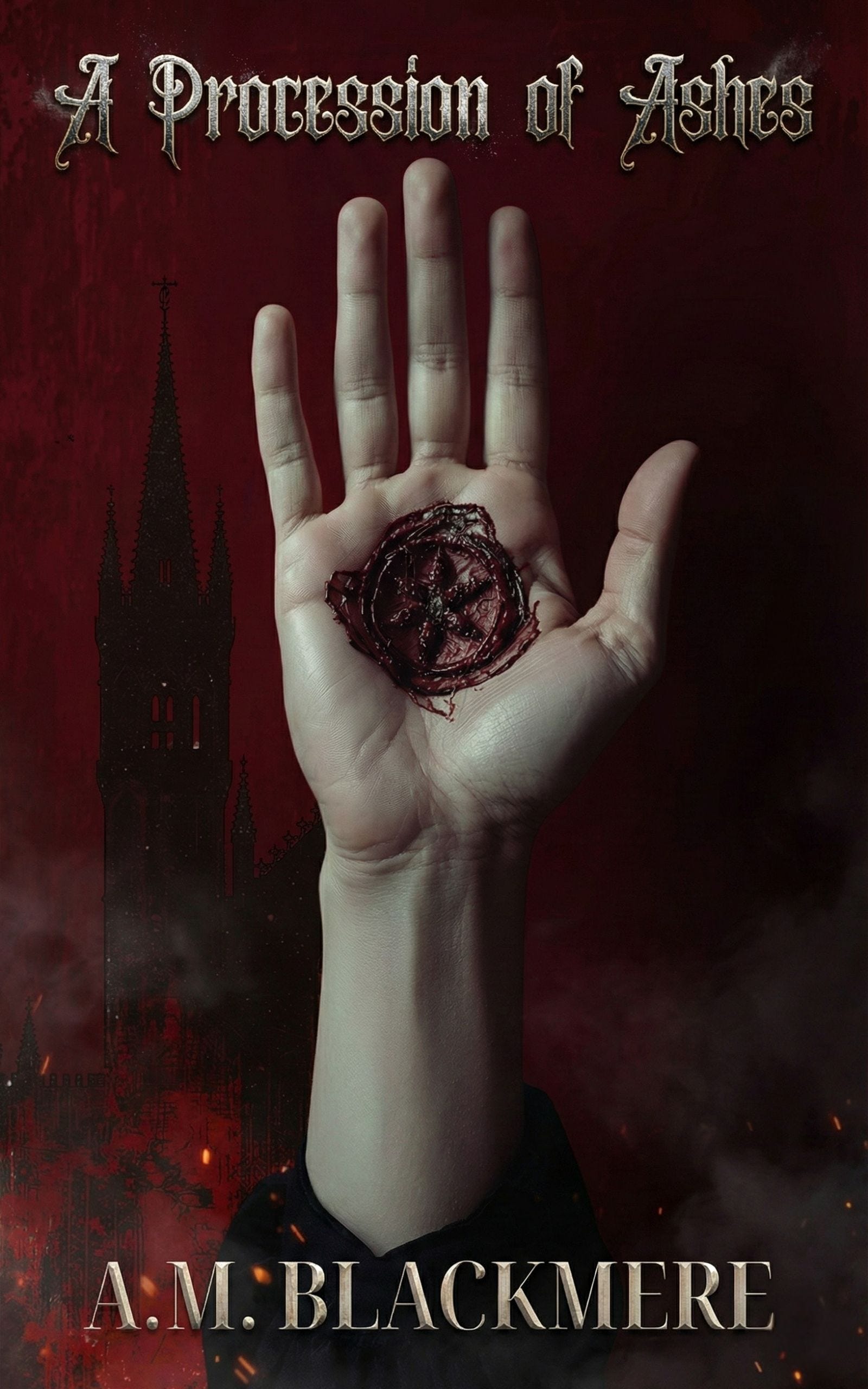
Tommaso Bellini eased his knife under the dead man’s chin. The stench rose: onions and wet iron, not sanctity. He told himself it was duty, not desecration, repeating it in his mind with every incision. The paring blade—borrowed from the apothecary’s wife—caught on cartilage. Bracing the elder’s jaw, his thumb went white. Flesh split; a tide of ochre blood ran down the table.
He paused, hearing only his boots and rain against the shutter. The quiet pressed close; he realized his jaw ached from clenching. The vestry stood empty beside his instruments: awl, tongs, wire loop, low-burning candles thick with tallow. No one would seek him until the sick children summoned him again.
No pustules marked plague. Beneath the tunic, lentil-sized bruises and nails burned from within. A thumb pressed a bruise; it yielded, haloed metallic.
He let the hand drop and wiped his apron. Rumors blamed the Brotherhood’s rituals, but he accepted only facts. Turning the head, he saw the collapsed larynx, the sealed airway. These matched the two children on Via del Sapone.
He recalled Bologna, where disease was puzzle, not punishment. There, they called sickness a question of nature, not God. He’d never wept, despite stench and nausea. He stitched the chest closed, rolled the corpse on sacking cloth, folded its arms. Candles guttered; shadows danced.
Outside, three women in shrouds and a boy with a battered hat watched the draped body. He stepped out.
“Another hour yet, and he will be ready.” His voice felt distant. “The dead instruct us more faithfully than the living, at times.” The words fell flat, too measured.
The oldest woman stiffened. “Is it the curse upon us?” she whispered. The boy clutched his hat.
“No curse. Only sickness.” Her gaze shuttered; she murmured half-prayer, half-insult. The others watched him with fear.
He closed the vestry door and exhaled. He pressed his palms together until his knuckles whitened. Death’s reek clung to him. Stripping off his apron, he crossed the hollow church with its ribbed pews and horn-patched windows. A girl swept without looking.
He climbed the back stairs to the former scribe’s cell—his workroom of notes, specimen jars, and damp books. Bolting the door, he sat and listed symptoms:
—No fever at onset
—Rapid cyanosis of lips and extremities
—Non-lymphatic bruising
—Blackened, brittle nails
—Thick, metallic blood
—Death within hours
He forced his hand steady as he wrote quickly.
He thumbed past the Sapone girls’ entries: black nails, welted skin, bleeding gums, lungs like half-cooked meat. Line by line, the mystery deepened.
A rhythmic thump drifted upward—the Brotherhood’s drums winding through the lanes. Each thud landed where his pulse should have been.
He rubbed stinging eyes, recalling the old man’s bruised hand and the child’s dangling foot. A knock rattled the door.
He unlatched it. Gregorio stood there, sleeves soaked and clutching altar linens torn into bandages.
“Another,” Gregorio croaked, not bothering to step inside. “The girl from the olive-press. The mother begs you to come before the Brotherhood arrives.”
Tommaso nodded. He pocketed his notes and followed Gregorio down the back stairs. The nave had filled—silent figures hunched in pews, knuckles white with prayer.
They navigated the side aisle past ancient women in damp shawls. A jaundiced widow spat deliberately as he passed; Tommaso pretended not to notice.
In the vestibule waited a red-eyed altar boy—one of the cobbler’s twins, his cheek marked by a healing dog bite. Without speaking, he jerked his chin toward the corridor and disappeared.
The olive-press stood at the edge of the flooded quarter, its stone wheel dark beneath the eaves. The girl lay in the passage, jacket buttoned, hair slicked with rain and something stickier.
Her mother knelt beside her, rocking with tight, reptilian motions. Her moans were low and wet. The pressmen lingered at the alley’s end, faces slack with the strain of too much to do and nothing to fix.
Tommaso crouched beside the girl, careful not to crowd her mother.
Rainwater beaded on her lashes; her eyes open but glazed.
“Did she take a fall?” he asked, voice as soft as he could manage.
The mother shook her head, fingers digging into her skirt. “She… she coughed once, then stilled. Then fell as though struck.”
Tommaso examined the girl’s hands: blackened nails, cracked bleeding beds, a strip of skin hung from her thumb. He pried her lips apart—her tongue swollen purple, choking from within.
“Had she taken ill before this?”
“No,” the mother croaked, and Tommaso recognized her. Isabetta Grimaldi—hair cropped close, fraying into her collar. He’d known her voice bright once, sharp as river water; now sanded raw. “She was ever strong. Never a day’s sickness in her life.”
He checked the girl’s neck—no bubo under the jaw, no heat at the pulse. Skin cold but not yet stiff. He pressed his ear to her chest—silence.
The pressmen withdrew, feigning interest in rain pooling in the lane.
He checked for breath again. Nothing. Pupils wide, blood weeping from her nose. A viscous drop pooled in the dimple at her upper lip.
He straightened. Faces waxy in the late gloom watched him. The rain had slowed; a bell tolled—once, then again, insistent and off-beat, as if struck by a hand unable to count.
“Carry her within,” Tommaso said. “I will return to make her ready for the rites.”
He searched for comfort in the words and found only their echo.
Behind him, Isabetta whispered a phrase he half-recognized—not from the Book, nor any catechism. Something raw, older.
He left them and walked into the street, feet tracing cartwheel ruts as if memory alone could carry him to the vestry’s safety.
That night wind shrieked through warped shutters. Tommaso hunched over his notes as a gust rattled the casement and snuffed his lamp. Papers scattered into darkness, leaving him staring into the black slit of street below.
Something moved there—rain, or something streaking the stones. From deeper in the city rose chanting, thin at first, then swelling into a cracked litany.
He pressed his cheek to the cold stone and peered through the shutters. The square lay still but for bodies gathered around the plague cross. Torches flickered, casting grotesque, jointless silhouettes. The Brotherhood paced in a slow spiral; their skin gleamed with slick, old wounds. At the center stood Aureliano—marked by a skull’s cut and ragged fringe of hair—arms raised as though conducting the clouds.
At the far end a girl stood, her cropped hair wild against a pale skull. Tommaso squinted, failing to place her among familiar faces. Her white-knuckled fist clutched something she pressed from shoulder to mouth.
The chant shivered, the rhythm breaking Tommaso’s breath, before resuming in a jagged, doubled tempo. The cross glistened under torchlight, its bandages and relic bones weeping beads of moisture.
Another gust snatched at the flames, and for a moment Tommaso thought the cross itself flexed, as if its binding sinews strained.
Shouts cut through the chant. The girl jerked back, arms raised, and Tommaso pressed harder against the wall, breath pinched.
She staggered, hands to her face. Her scream tore through the square, ricocheting off the buildings. A dark stain spread down her chin so fast it seemed painted. Droplets spattered the stones in fat, blooming circles. Then she convulsed, folding at the waist; the sound was a hoarse, wet gurgle.
The Brotherhood surged but merely closed the ring, chanting louder, faces hungry and afraid.
Tommaso wrenched the window wider, ignoring the cold. The girl collapsed to her knees, hands clamped over her mouth, and vomited blood—so much, so dark it steamed against the cobbles.
The chant slackened as the men shrank from the red pool. Tommaso’s mind reached for the familiar—ruptured vessels, hemorrhagic fever—but beneath that reasoning something darker bloomed: a sense that her blood burst not from illness but from containing something inside her.
He watched her convulse again and waited for the noise to end.
It didn’t.
I like how things are starting to unfold, and I like Tommaso's character. He's like a medieval forensic pathologist (I love that major; if I'd chosen medicine, I'd have been a pathologist). It's clear from the chapter that there's some other disease besides the plague that's affecting people. But something tells me it's not that simple.
Nice pacing, details. It moves quickly, but not a hurry. The reader hurries to see what happens. The short sentences are nice, and I wonder if the whole story has this quick rhythm. Lots of good description, but not overwrought. Looks like a good story; this the first I've read of it.