
The Unfinished
A Short Story of the Null State


This story was created from a collaborative prompt with OliveTree, an excellent writer. Be sure to check out her work!
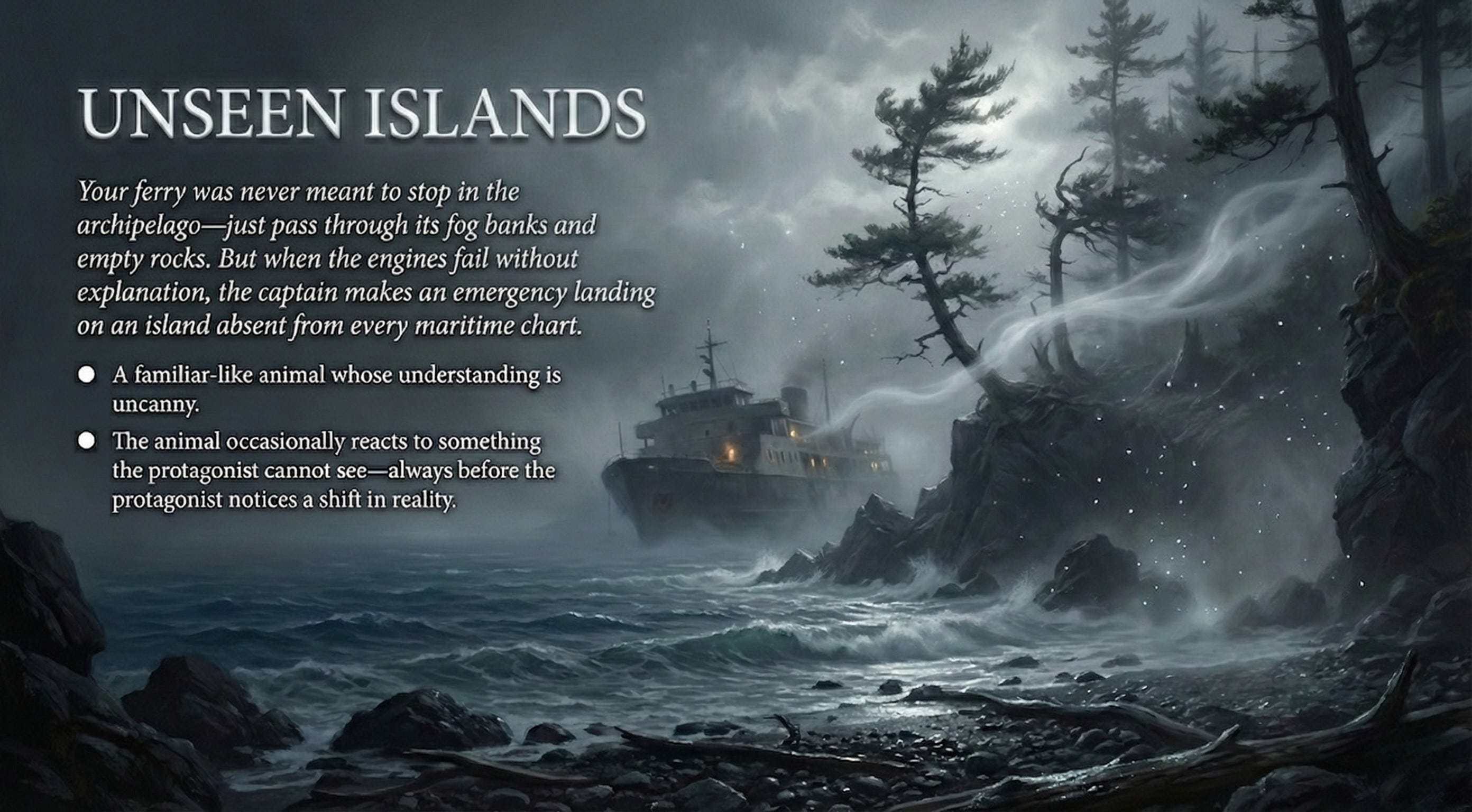
By the time our hull scraped the island’s jagged stones, no one was watching the water. Passengers clutched their blue-lit phones, hoping for signal at sunrise. The ferry—built for inner routes—felt too light for open straits, too aged for surety. The scrape jolted us only slightly, a mere cough before the fever.
I rose slowly. Wick, already uncurled beneath my seat, made no sound—only the telescoping of his shoulders and that question in his eyes: Now? The air tasted of ozone and spent fireworks. Rain traced wobbly lines down the windows.
No one recognized this island. The captain, thin and beagle-faced, said nothing at first; he pressed his hat and stared at the fog-lashed shore. Then, in the tone of a minor detour, he said the engineers would “sort her out” and that we should keep to the lower deck.
But the lower deck was taking water. I heard a gurgle beneath the nav suite, a slap-slap where the linoleum buckled, each blow closer than the last.
Passengers huddled in the galley, faces drained by harsh fluorescence, replaying the crash in their minds. Wick pawed at the hatch. I opened it and a living cold rushed in—wind with a memory for broken promises.
The dock, which should have reached into darkness, ended ten meters out, a mangled suggestion of wood and blank water. The island itself was uncertain: a low heap under fog, as if roughly sketched and abandoned.
Wick led, silent paws on splintered planks. I counted each step—a compulsion even as my legs trembled—and somehow reached land without recalling half the crossing.
The fog here moved oddly: pooling in shallows, then flowing uphill, like an untrained actor rehearsing a scene.
I followed Wick as he threaded a line through undergrowth, over matted seagrass and glassy stones. Every few meters he paused, amber-rimmed pupils reflecting not my urgency but some private calculation.
Atop a low rise, the ground abruptly turned to concrete, open to the elements, scored with parallel lines and ghostly rectangles—as if a giant began a foundation then lost interest.
A shiver passed through me, and Wick felt it too—his hackles rising in a ripple from neck to tail. Even when I knelt to stroke him, his spine stayed tense. He tilted his head, alert to something I could not hear. No voices—just the wind, and that else.
We crossed the slab. Fog thickened, then thinned, always shifting. My boots echoed hollowly, like on unfinished garages or failed developments. Faded blue and orange lines, some straight, some skewed, suggested rooms without walls; empty doorframes framed nothing.
Ahead, misshapen grass flanked a corridor of open air. Wick walked with new certainty, as if trusting this architecture over the wild. I followed, counting again—heartbeat to footfall—seeking rhythm in the absurd.
We entered a copse of birch, trunks the same blue-white as the mist. The scene felt marginally more real. The trees stood evenly spaced, limbs branching at mathematically pleasing angles, as if pruned by an unseen hand. The ground, oddly free of leaf litter, held only my breath’s rasp and Wick’s claws on stone. He stayed at my side, more beast than companion.
In that copse the world flickered—not a blackout, but a fluorescent bulb hesitating. The trees became thin pillars receding to a vanishing point. The sky flattened into a low, coffered ceiling that rippled like remembered clouds. The ground shifted slick to dry and back. When my vision cleared, Wick growled at a new shape.
At the corridor’s end, beyond the last birch, stood a silhouette: half-formed, the vague suggestion of a person without features—no face, no joints, only gaps where the world bled through, like an unfilled template. Its only solidity was the shadow it cast: black, sharp, impossible in the fog.
The shape didn’t move. But the air around it did, like heat above a flame. It waited, and I waited, and then Wick, with none of the usual warning, lunged.
He shot past me in a gray streak, and for a moment the thing quivered—not in fear but as if its code glitched. Its outline stuttered, splitting into three frames—one for each stride of Wick’s attack—then reassembled, impossibly, with Wick on the far side, hackles down, tail clamped.
He howled—a raw wire-sound that made my teeth ache. The silhouette mimicked him, arching its back in a hollow threat. A gust of fog sent both Wick and his echo stumbling sideways, nearly together.
The thing didn’t vanish—there were two. The second, a scribble beside the first, trailed errors across the ground. The island seemed to register each misstep, tilting reality and rewriting itself.
A pulse of static surged, and my ears buzzed with Morse-like clicks: long, short, long. My knees buckled. Trees flickered between birch and pillar as the corridor compressed, and I tasted the wet-copper tang of Wick’s panic. He paced in tight circles, snarling feints at the shadows, which retreated with algorithmic precision.
I wasn’t built for panic—or so I’d believed—but my hands trembled, fumbling for pockets. The urge to flee crackled through my bones. Wick darted, and with each pass the shadows refined themselves—gaining limbs, tilting heads, then a strobe-lit mouth.
We ran—not a brave run, not a heroine’s run, but a desperate, heads-down bolt through trees into an impossible clearing. Beneath us lay a silent carpet of alternating textures—shag, jute, crushed velvet of a childhood I’d never known.
Wick’s claws were silent here. The shadows vanished, yet each step echoed, as if something was learning to walk. The corridor yielded to a walled illusion: a room defined by spatial cues. At its center floated the outline of a table, bearing one perfectly centered sheet of paper.
Wick froze. Silence fell. My breath caught as I reached for the sheet, despite knowing I shouldn’t. It was blank—save for a faint looping line in my handwriting, though I’d never written it: Begin again.
I dropped it. The world skipped in a flicker: ceilings collapsing then ballooning. When it settled, we were elsewhere—Wick pressed to my shin, his fear stinging my nose like long-sealed vinegar.
No carpet—just a gritty, gesso-white floor fading into horizonless gray. Walls solidified, windows remained smudged voids. The air was dry, unnaturally warm, like a cheap rental’s noon. My cough echoed, flat and final.
I sought an exit, but geometry conspired against me: three steps forward unspooled the room sideways, four back reversed it. Vision telescoped. I reached for Wick—gone, yet there, at space’s faultline, growling low and almost human at a new figure.
The silhouette returned, more finished: sharper edges, dusty flesh-tone fills, like a mannequin parody. Its proportions skewed beyond description. It mirrored my stance—slouch, wrist angle—and lagged half a beat behind.
I raised my hand. So did it—more humiliating than terrifying, like a child mocking your name.
Wick lunged. The thing bent at the waist in one smooth motion, revealing a faceless head with only a flat, uncommitted mouth-line. It reached for Wick, who twisted, hit the floor, and slid between its legs. A wet slap—his tail against a wall?—and then he was back at my feet, pushing me backward.
The figure straightened. Its smile—if that’s the word—stretched, unzipping into a wider, eerier mouth. A scraping, click-tongued eh made my molars itch.
I backed away. It recalibrated, copying me while eyeing my next move. It didn’t just follow—it needed me to know it was following. Its blank stare hungered for approval, waiting for instructions.
I said nothing. Maybe that was the mistake.
A second, half-scale figure blinked in, its limbs refusing to coordinate. It tripped, plunged through the floor—arms windmilling, mouth a rictus of surprise—and dissolved until only its cartoonish feet hovered above the void. Wick barked triumphantly. The first, fuller figure cocked its head, curious at its shadow’s misbehavior.
Then I recalled the exit—not like an address, but like the burn’s hot shape or the sharp pitch of a scream. I blinked; the room warped, corners bending, floor rolling like a ship’s deck. Wick dove for the seam where the horizon glitched, a slit of solid reality. I followed, unthinking, each step erasing what came before.
The next corridor was narrow and unstable. Walls shifted—drywall, cinderblock, pressboard—sometimes scrawled with pencil notes, sometimes exposing insulation, sometimes disappearing entirely. The air swung between glacial cold and feverish heat. A radio ghosted one bar of a song, endlessly reshuffling itself.
The world fractured. I glimpsed others—the passengers, the captain, engineers—cut-and-pasted into impossible rooms, forever mid-action. Faces blurred, voices inaudible, hands gesturing at emptiness. Occasionally I recognized a gesture: a man steadying on a rail, a woman cradling her phone. Sometimes it was me, split between two frames, unsure which version would survive.
Wick advanced as if guided by a map—reading edits, tracing seams where the world updated. He led down a staircase that unspooled underfoot. Below, the fog thickened—no drift, no eddies—just an implacable mass asserting its reality.
Ahead, the reformed silhouette waited, hunched, arms loose, head bowed as if embarrassed by its persistence. Wick halted, tail low, eyes fixed. We all paused, the unfinished sentence hovering, terrible in the air.
This time, I spoke two words, each thick with spit and fatigue: “Let us.” Unfinished, unneeded. The silhouette twitched, then stepped aside, flattening into an afterimage smear, like a peeled photograph.
We ran, ignoring the echo, not glancing back. The corridor collapsed behind us, shuttering in vertical blinds with each stride. My lungs burned with cold and panic, but I pressed on, counting steps until they blurred into one endless digit, guiding us to the next threshold.
The floor pitched steeply; we plunged onto the starting slab. The once-faded blue and orange lines now screamed with pigment in the damp morning. Wick stumbled, recovered, nipped at my boot, urgent. Behind us, fog pressed into the clearing, an advancing tide torn between drowning or displaying us.
The island’s taste changed—not ozone and rot, but the metallic bite of post-lightning air. I braced for another flicker; none came. The world held steady, for now. Wick leaned against me, trembling, and I felt the strange relief of remaining unfinished.

 | A guest post by
|
Damn. This was unsettling for sure. Gave me a bit of Anihilation vibes, which I think is perfect. Congrats for making me feel creeped out haha
Excellent eerie encounter. I suppose the thing let them through but definitely will not be accommodating if they're dumb enough to return. Cool story.