
The Substack Marketing Tool You’re Probably Using Wrong
On Substack Notes, the new scheduling feature, and why this format is not what you think it is.



There is a small button on your Substack dashboard that most writers treat as an afterthought.
It sits beneath the main compose window, beside the camera and video icons. If you have been using it at all, you have probably been using it the same way most people do: to share a quick thought, post a fragment of your work, announce a new piece. The digital equivalent of clearing your throat.
I want to make the case that this is a significant mistake.
Substack Notes is not Twitter. It is not Instagram. It is not a place for hot takes, status updates, or the quiet performance of productivity. Writers who treat it that way tend to accumulate restacks from other writers who are also performing productivity, and that is more or less where the loop ends.
The writers who treat Notes as a deliberate acquisition tool tend to experience something different.
The Scheduling Feature Changes the Equation
Substack recently added the ability to schedule Notes in advance.
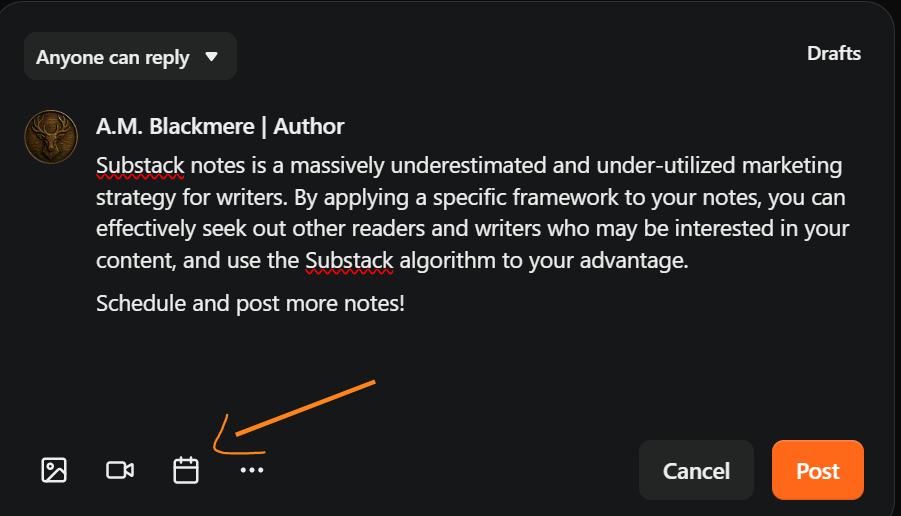
This is a small addition with real weight behind it.
Here is why it matters. The Substack algorithm is genuinely unusual. Unlike most social platforms, where content decays within hours, Notes have a discoverability life that extends across the web. Substack has been actively building its search and recommendation infrastructure, and Notes from writers in adjacent genres surface to readers who have never encountered your work before. A Note posted at the right moment on a Thursday can find a reader on the following Saturday, or the week after that.
Scheduling allows you to treat that window as a planned event rather than a spontaneous one.
Most writers are sporadic with Notes because the act of writing and posting them lives in the same mental category as social media: something you do when you remember to, when you have something worth saying. Scheduling separates the writing from the posting. You write when the thought is sharp. It publishes when the timing is right.
That is not a small thing for writers who are also trying to, you know… write.
Why This Platform Pushes Notes Further Than You Think
Substack’s discovery infrastructure is designed to surface content beyond your existing subscriber base. When a Note performs well, it circulates. When it gets restacked by the right account, its reach extends significantly. Some Notes continue accumulating subscribers for weeks after they are posted. This long-tail behavior is specific to how Substack indexes and surfaces content, and it is not something Twitter or Instagram can replicate.
The implication is that a Note is not ephemeral. It is a document with a discoverability window that stays open far longer than most writers assume.
This should change how you think about what goes into one.
What a Note Is Actually For
I spent several months treating Notes the way most people do: as a place to share excerpts, tease new posts, and occasionally post a thought about the writing process. My engagement was fine. My subscriber growth from Notes was not.
Then I looked at the actual data from my own publication.
What I found changed how I write them. Not the voice, not the subject matter. The underlying structure. Notes that convert readers into subscribers share a specific anatomy. It is not intuitive. It is not what most writing advice tells you. And it has nothing to do with how interesting or well-written the content is.
There is a framework. And it works.
The Framework: What the Data Actually Shows
I want to be clear about what I am about to share. I am not a social media strategist. I write dark historical fiction about plague, rot, and the long shadow of death. I came to this framework by looking at my own numbers and asking a simple question: what was different about the Notes that actually moved the needle?
Here is what I found.
The numbers first:
Notes are the single largest identified source of subscriber growth for this publication. Of the subscribers I can attribute to a specific source, 478 arrived through Notes. The next largest category is Substack app discovery, which likely includes traffic generated by Notes activity in the first place.
A single Note, posted in November 2025, drove 118 subscribers. 107 of them arrived in a three-day window.
That one Note represents roughly 10% of my total lifetime subscriber count. It was not a fiction teaser. It was not a post announcement. It did not include a single line from my work.
Two other Notes drove 54 and 42 subscribers respectively, with the 42-subscriber Note still accumulating slowly weeks after posting through restacks and Substack search.
The pattern across all three is identical. And it is not what I expected…
