
The Scrimshaw Prophet
One Man’s Fight to Carve His Fate Against the Sea

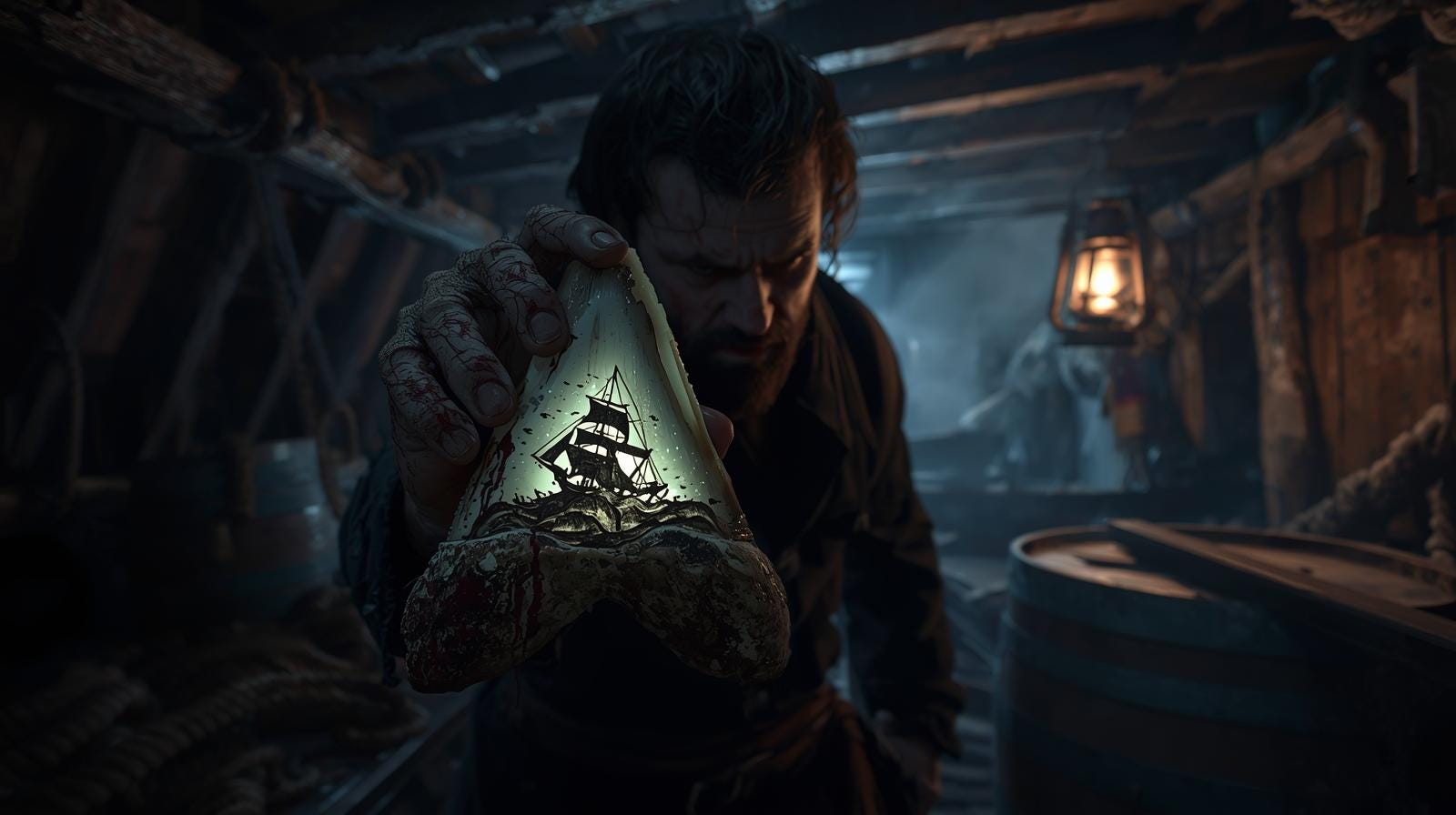
The tooth gleamed like moonlight caught in bone as I carved the ship’s ruin.
Each score of the graver’s tip was a bright, wet thread, bled out from the fossil silence beneath my hand. The tooth was new-come, fresh from a calf struck off the coast of the Crozetts, still holding the stink of whale-oil in its root. I’d boiled and scoured it three times before I dared to lay the point and begin, but even now, in the hush below decks, I fancied a pulse in the ivory when my thumb pressed the grain.
The hold was cold and narrow, full of casks and silence, save for the see-saw of the hull and the ticking of lantern glass. Salt sweated through the planks. The air was thick with old brine and the thinner, sweeter scent of sperm candle burning overhead—a smell like almond and rain. I hunched over the makeshift bench, cradling the tooth in a rag. Each breath clouded the blade, and each breath came sharp, as if the sea itself had fanged the wind that morning and left me gnawing its leavings.
By rights, I should have been aloft, eyes peeled for spouts on the gray rim, but fortune or providence had left Sander up the mast and me below, nursing a hand half-mauled by line-burn. The captain called it malingering, but let it stand so long as my right hand could carve. The ship—our ship, the Goliath—rolled lazy in the troughs, sails slack, the horizon a smudge.
I had learned not to look too long at the finished works. In the first year—before the lines on my palms remembered the shape of the graver—I had carved a pod of whales beneath a full and silent moon. Two months on, off the Azores, we found them exactly so: six bulls and a single cow, limned by a moon so swollen it seemed to sag against the water. I showed the carving to Sander. He spat and said I’d wasted the ivory on sea-lore.
But when the speckled calf I’d etched in the corner spouted blood, just as the tooth foretold, Sander would no longer meet my eyes. The men stopped asking for likenesses of sweethearts and started slipping me coin for luck charms—small rounds of bone with anything but whales on them. I kept those requests, and their fears, in a velvet pouch tied to my belt.
What I carved came true. It was as simple as hunger, as thirst, as the itch of salt on healing skin.
I let the point slip. It scored the shape of the mizzen splitting in two, a plume of splinters drawn skyward by wind and violence. The ship below was not Goliath, not precisely—my hands never did take kindly to symmetry or flags—but the battered hull on that tiny stage bore our scars as true as any chart: the bulbous patch on port, the odd crook to the fo’c’sle.
Her crew, sketched in the cramped margins, were no better than ghosts—pale, faceless, smeared by the broad of my thumb. I tried to see them as strangers, but the bodies tumbling from the rails wore the black slops and red wool of our own men. One figure clung to the wreckage, head turned away. Yet there, above the brow, was the round dent from last year’s fall—a wound I carried still, under a mess of hair and pride.
I had carved myself into the wreck. A joke, a slip, or maybe something worse. I stared at the tooth, hoping the lines would swim and blend. They sharpened, instead—the moon cut in a thin sickle above the carnage, the whale below curling with a child’s spiteful smile.
I set the tooth down, hands shaking. For a moment I simply listened: the shush of hull, the lantern ticking, the quick, traitorous drum of my own heart. In the dark of the hold, with the world reduced to oil lamp and bone, I felt the future closing like a fist.
I tried to laugh it off. The sound came out thin and went nowhere. I slid the tooth back in its rag, set the graver beside it, and pressed both to the very bottom of my sea chest. Nailed the lid shut for good measure, splinters biting my thumb raw. Still, when I tried to sleep, I felt the carved moon floating inside my skull, bright and bone-cold.
By next morning the hold stank of bilge and something sharper. I rose, knuckles numb, and found the tooth waiting on the bench, laid out with my tools as if I’d never left. It was unchanged: the split mast, the slack-jawed moon, the little figure with my ruined brow. I took it in my left hand, the bad one, determined to end it.
I tried the galley fire first—waited for the cook to step above deck, then hurled the tooth into the blue-white heart of the flames. Coals hissed and spat, but the tooth did not blacken or crack. I fished it out after, bare-handed, expecting a bite, and found it cool as stone, the lines of the wreck flickering with shadow.
I took a mallet and struck it—first gentle, then harder, then with all the force my shoulder’s knot could raise. The tooth rang out with each blow, a dull, vexed note, but did not chip or craze. It left a dent in the galley table, a fine crescent, but nothing more.
I wrapped it in sailcloth and heaved it overboard at dawn, when the world was empty except for the shriek of gulls and the hush of my own breath. Watched it arc out, a pale hush above the slate water, and vanish with the tidiest of splashes. The current took it west, or maybe south; I watched until the sun rose enough to sting my eyes. The weight did not leave my arms, but only settled deeper, like a bitter seed lodging in the chest.
That night, the weather turned: a high cloudbank swept in, thick as gruel, and wind needled spume through every seam. I was called up to reef the topsails, bandaged hand clenched to the shrouds, and the whole time I felt the gaze of the other men, sidelong and bright. They muttered behind scarfed faces, voices rough as deck-cord. When we came down, Sander shouldered me hard, no accident in it.
“Heard you tossed your luck overboard,” he growled. “Hear it’s bad luck to throw the sea her own bones.”
I could not answer. I did not tell him, or any man, how the tooth was waiting for me at the foot of my hammock that night, slick with seawater, the carving more vivid than before. The deck rolled beneath, but the tooth did not so much as tremble. I put it back in the chest, lid unlatched this time, and left it to be found or not.
From then on, the men gave me space. Not respect, never that, but a new sort of berth: a ring of cold air at mess, a shuffling aside in line for the scuttlebutt, glances that lasted a shade too long and never quite met my eye.
Two green boys approached—not together, but on the same night, as if spurred by the same bad dream. They came with trinkets; a finger bone, a tobacco plug, a coin cut with a cross. I carved what they asked—an anchor, a woman’s face, a hand clutching something I could not name—and sent them away, praying they would break the chain.
The second boy, Cormack, returned a week later with fresh scars on his cheek and a tooth gone from his smile, but nothing more. He thanked me in a whisper. The first fell from the rigging three days after, and the tooth I’d carved for him—his proper tooth, not the whale’s—was found in his pocket, split down the seam with the carving untouched.
Below decks, time thickened. The ship’s movements grew erratic, the pitch and yaw grew wrong, like a trick of the tide. We would roll steady for hours, then catch a lurch that slapped men from their hammocks and made the barrels clatter in their moorings.
I slept less, carved more. If I closed my eyes, the tooth waited behind them, always brighter, always nearer. I tried to etch other things—a mermaid, a whale’s eye, a storm forming over distant land—but my hands betrayed me. Each time, I would blink and see the lines of the shipwreck, fine and indelible, pressed into the bone.
I started to wonder if I was carving the future, or if the future was carving me. I would set each line with a purpose and watch, powerless, as the world slid to fit it—never knowing if I made the groove or just fell into it. The thought was a worm behind my ear. I grew sick with it.
One morning, after a night slicked with fever and the taste of brine in my teeth, I woke to find the graver in my good hand and the tooth pressed under my cheek. My knuckles were bloodless, cords standing out sharp as rigging. I must have slept with it clutched like a child’s charm. Or maybe I had never slept at all.
I sat up, dizzy, and stared at the shipwreck on its face. The moon’s cold edge, the splinters, the tiny, faceless crew. My own carving stared back, so alive now it seemed to shudder in the lantern’s pulse.
I made a decision—a brute, blind thing. I would not have it. I would not be another line on the whale’s tooth, a foregone casualty. I set the graver’s point hard against the tiny man’s chest and began to gouge.
The scratch of iron on bone was a scream no ear could hear. I carved over the figure and fashioned a plank beneath him, a length of driftwood rising from the foam. I scrawled a line of water beneath his arms, forced the little man to clutch the plank and cling. The work was ugly, desperate.
The ivory resisted; the tooth heated in my grip, sweat blurring my vision. The graver snagged and slipped, biting the pad of my thumb, and once, I nearly drove the blade through my palm. Blood welled and trickled, dotting the tooth in garnet flecks before I pressed on, refusing to stop, refusing the future the bone had bitten for me.
I carved until the lantern’s light guttered and the world shrank to the hot oval of ivory, raw and trembling in my fist. The new lines stood out jagged and black, rough as a wound scabbed over too soon. Where once the little figure floated among the dead, he now clung to wreckage, arms ringed white, head above the waves. The moon above was notched and eaten, the ship a splintered memory behind him. It was ugly work, misshapen and desperate, but it was work, and it was mine.
The next day, the clouds stooped lower, pregnant with iron and a strange, coppery light. The wind built with a mindless, incremental hunger. We were called on deck at dawn when the sky had gone to wool and the sea below heaved—no rhythm, just a mounting, sleepless agitation, as if the whole of it convulsed in dread.
The men worked the rigging with set jaws, boots slick with brine, eyes darting from horizon to deck and back, as if looking for a sign of a sign. I kept the tooth in my jacket pocket, heavy as a verdict. When I reached for a line, it thudded against my ribs. When I shimmied up the shrouds, the graver’s point jabbed my thigh like a burr.
All day the storm gathered itself, the light thickening from pewter to lead, wind rising in fits that scoured the deck and stripped words from the air. The captain raged in the wheelhouse, but I heard the tremor in his orders. Sander bared his teeth at me, not as a warning but a prayer. Even in the spiral of the storm’s approach, I saw the men’s eyes cut to me, quick and furtive, as if I’d become a figurehead lashed to their fear.
By nightfall, the waves had built themselves into mountains, black against the bruised sky, the wind a constant, keening animal. I braced below decks, wrapped in a tarpaulin and my own stink, the tooth in my fist. The ship bucked and twisted, timbers in my jaw, holding on as the beams above sang and split and the lanterns swung like the final hours of a clock gone mad.
Casks broke loose, rolling in the dark, slamming ribs and knees. I pressed my back to the mast step and let the world come apart.
The storm did not arrive so much as unfurl, a thing too huge for the sky that pressed its belly down and ate the ship by increments. Each jolt was a new geometry of pain: a barrel catching me at the hip, a spar scything overhead to take Sander in the mouth, blood painting the planks in a loose, impossible star.
Men wailed and vanished, flung into the maw of noise and black. The captain was last I saw, lashed to the wheel, cursing the wind—then nothing, just the thunder of water and a cold, marrow-deep silence.
We broke. That is the plainest way I can say it. One moment the ship was a thing you could name, the next it was fragments and darkness, salt and agony, the tooth still clutched in my hand.
I remember a scream, not my own, and then the world turned end over end, sucking my breath and reason. My head struck something—iron, wood, I never knew—and bright beads danced behind my eyelids, vivid as the stars I had not seen in weeks.
I woke in water, slick with oil and blood, mouth full of salt and an ache in every tooth. The tooth itself was still gripped in my palm, the graver’s tip scored deep into my forefinger. I surfaced. Gasped. Clamped teeth on the first air, raw and coppery, as if the storm had torn open not just the sky but the world’s own arteries.
A rag of light showed me water black with oil and the staved hull of Goliath upended, her bones bared to the elements, deck torn clean through like a mouth ripped at the seam. There were bodies—some bobbing, some hidden, one or two still clutching at hawsers or cask. I shouted, but my throat barely made a whisper.
I tried to blink the salt from my eyes, but all I could see was the tooth, pale as a promise, clutched in the web of my hand. I had bought myself a future, but I paid every hour for it.
The next dawn found me lashed to a spar, the world around me slick with wreckage, the air itself stripped raw. All that day, the wind torqued the bodies into grotesque tableaux, arms thrown up in silent, final appeals, faces gnawed clean by salt and—later—by the things that followed the ships for weeks, waiting for gaps in the hull.
Cormack’s wrist surfaced near dusk, the anchor I’d carved for him glinting in the red light. I did not pray for him. I could not even summon the words.
The ocean was a field of shards: staved casks, torn sails, lengths of cord and painted wood, all drifting as the storm abated and the world resolved into silence—so huge it pressed on the ears like grief.
The tooth, still bright in my hand, had split me a place among the living, and I took it with a sick gratitude. I lashed it to my neck with a strip of tarred line, cradled it like an old wound.
I drifted for days. I have no count of them, only the sun’s arc and my own growing thirst, the taste of salt becoming my tongue. Hunger was a simple thing, a gnaw that never left, but thirst was a fever.
My fingers traced the grain of the driftwood, feeling each ridge and whorl as if it were ivory beneath my graver. Even as my vision dimmed and my lips split and bled, my hand would not cease its trembling motion—carving invisible figures into the wood, unable to stop, as if in this final act I might still change the story written in the waves.
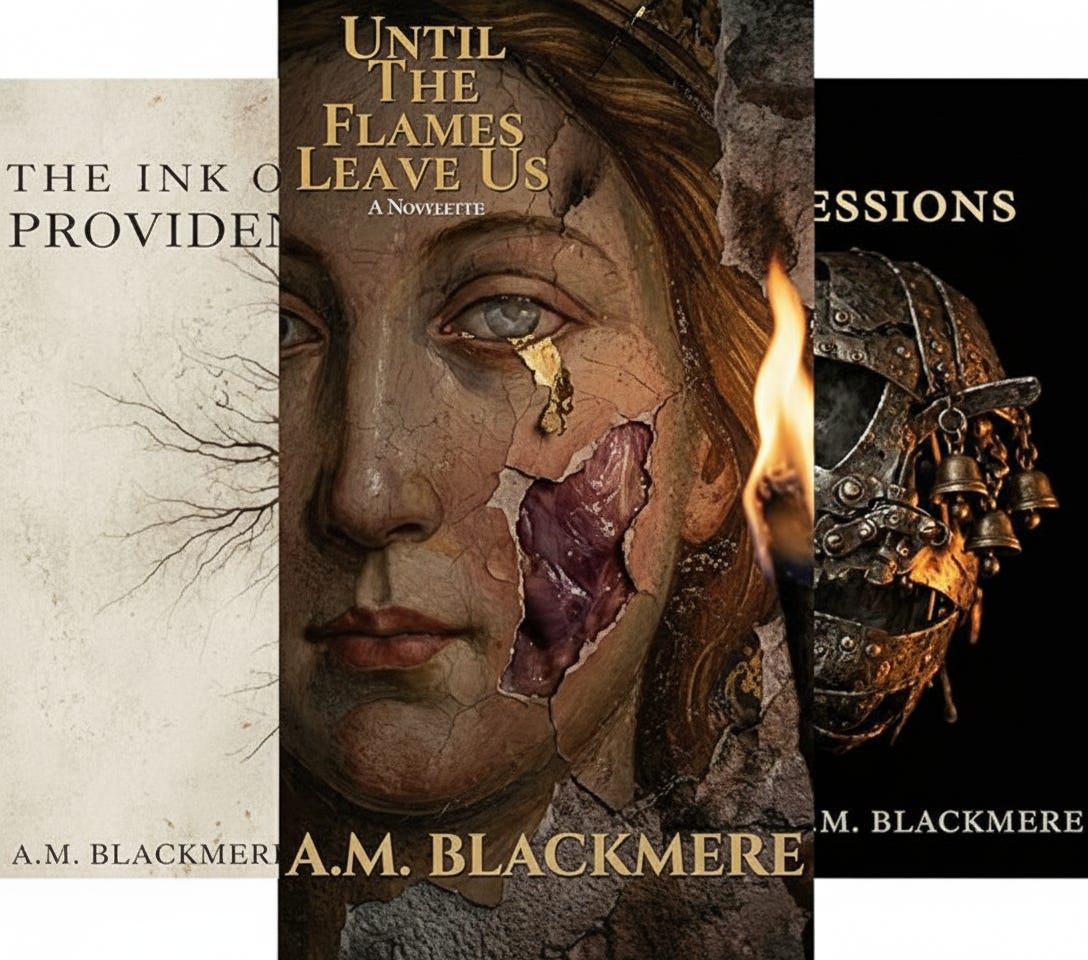
CHECK OUT MY SELF-PUBLISHED WORKS HERE!
A visceral and atmospheric read that feels cinematic as it explores a supernatural tale at sea, playing out in real time rather than through the slurred oration of a withered sailor residing in the dimly lit corner of a seaside pub.
Such an evocative and atmospheric story! Clearly well-researched and fabulously written. Just really good and original.