
The Marrow Tithe
A Folk Horror from The Week 7 'Blackmere Storycraft' Prompt

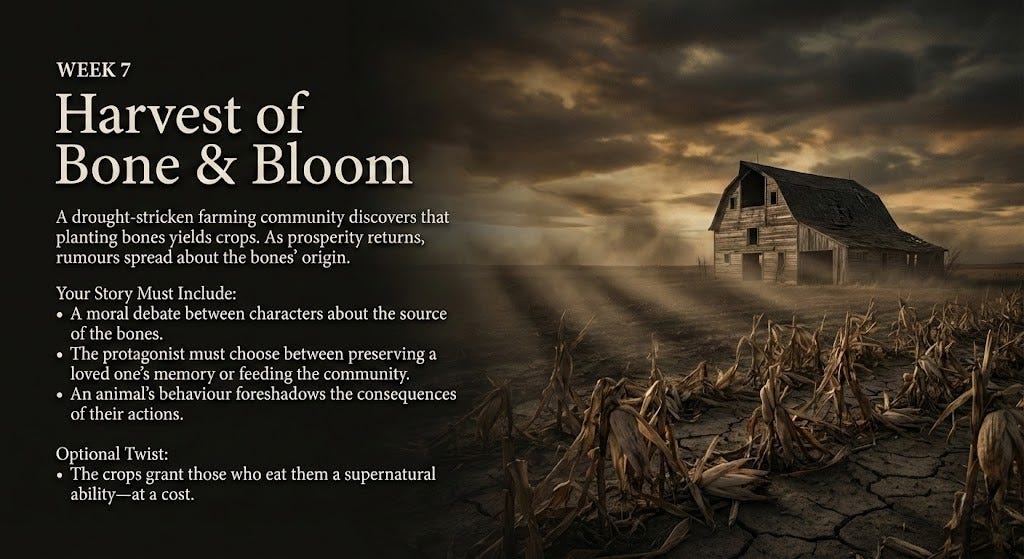
This story comes from the Week 7 Prompt of my ‘Blackmere Storycraft’ Prompts. Each Wednesday, I post a prompt into my free subscriber chat. It is non-competitive and meant to be a way to share your work while getting the creative juices flowing. Come join!
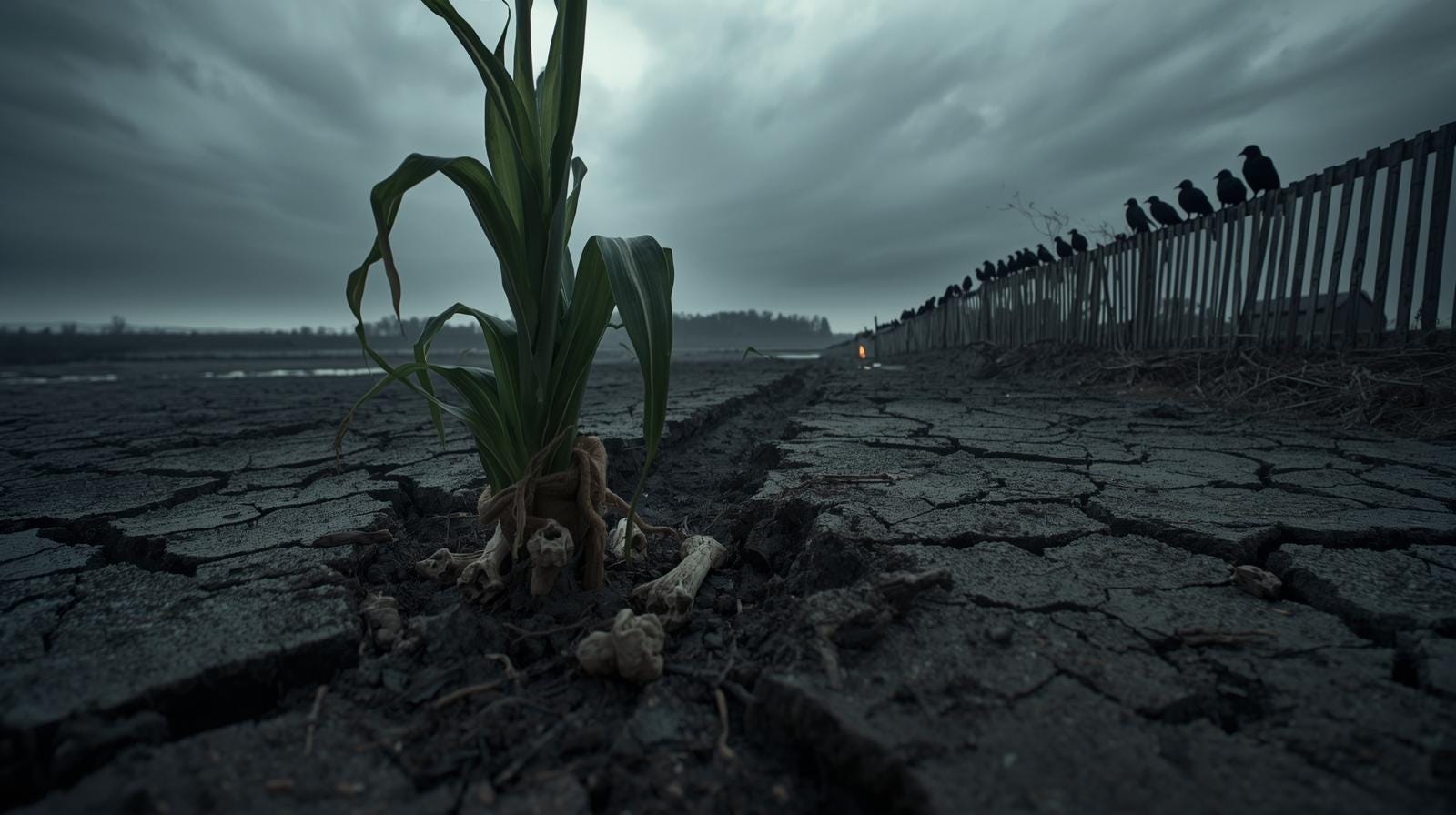
By first light, the ground behind the Hale house was split open as if by a dry hand dragging nails through clay. Corn stalks—the last of last year’s seed—hung bent and tasselless, their shadows cast thin and faint along the furrow. Calder stood between two of the stalks, a damp satchel pressed against his chest, and watched as mist drifted up from the ditch and tangled in the fence wire.
He knelt, the hem of his shirt darkening with dew. The satchel gave off a smell of vinegar and lye; its drawstring was singed, the letters of Mara’s name barely legible beneath the soot. He reached in with fingers as brittle as the soil. Each fragment of her had been boiled, scoured, sun-bleached until colorless—a jaw crescent, the metacarpal of her writing hand, the thick gleaming cup of her skull. He worked the pieces loose, one by one, laying them in the furrow like coins into a well.
The sky over Grayreach was a thin milk. To the east, the river glimmered only in sections, screened off by willows that had outlived most of the town’s children. Calder pressed the first handful of earth back into the furrow, then the second, then stopped, shaking. He bowed his head. The silence of the field was not a silence at all but a latticework of insect voices, the hot rasp of his own lungs, the persistent shuffle of wind in stalks dry enough to ignite if he looked at them hard enough.
It took him three tries to bury her. Each time he thought he’d managed, the wind would shift, and he’d see the lip of her skull, pale against the mud. Each time he started over, he pressed his fists into the ground until the nail beds turned purple. He packed the last of the earth flat, palmed it smooth. The ritual did not allow for a cross or stone; only the shallow rise of the furrow would mark the place.
He stood, wiped his hands on the thighs of his pants, and waited. The field waited with him. Calder’s eyes drifted shut.
He dreamed standing up—a memory of Mara’s last days, her lips chapped so badly he had to dab them with oil, her voice gone but her eyes intent, drilling through the world to something he could not see. He dreamed the sun was stuck at the rim of the horizon, refusing to rise. When he woke, it was because his dog was pawing at the back of his leg.
It was a little mutt, part terrier, something else, ribs showing through the fur. The dog’s eyes were wet, its tongue flicking out, tasting the morning. Calder put his hand on its head. “No,” he said, the word hard and useless in the open air. The dog crouched, tail down, but did not move.
He staggered back to the house. The walls there were thin, the color of gruel. On the front steps, he set his boots together, side by side, then went inside and poured water into a tin cup. He drank with his head tipped all the way back, throat exposed to the ceiling, to Mara’s shadow on the far wall. He stood for a long while, watching the color climb in the eastern sky, turning the field to a sea of dirty gold.
Something scraped outside. Calder was on his feet and through the door before he’d registered moving. At the edge of the field, the furrow—where Mara lay, where her bones pressed against the roots—was not as he had left it. The earth there was damp, almost black, and in its center a single stalk of corn rose, green as April, thick enough to wrap both hands around. He walked to it, slowly, as if afraid to step on a buried wire. The stalk was already as tall as his chest.
He reached out. The leaves were cool and wet, smelling of something faintly sweet and sharp. He looked down, expecting to see the ground churned up, a residue of ash or clay. Instead: the furrow had sealed, its seam almost invisible, a ribbon of loam tracing the line of her grave. He bent to touch it, and the new corn leaf flicked his hand, dampening his fingers.
The wind turned, bringing with it the hum. It was faint, at first, like the thrum of bees in late summer. Calder set his palm flat against the stalk. He felt the vibration there, a pulse traveling up from the earth.
He heard, then, a sound he had not expected: the pigs. Three of them, mean-eyed and bristly, making for the fence line at the far side of the field. They crashed through the dead stalks, grunting, their hooves sharp enough to break the baked mud. When they reached the new green, they did not graze; they circled, snouts lifted, squealing as if in protest or alarm.
The dog held back, watching, ears flattened. Calder turned to look at him. The animal was shaking. “No,” Calder said again, softer this time. The dog bared its teeth, a noise rising in its chest—a whine edged with something like warning.
Calder walked the perimeter of the field. As he passed, the green stalks shuddered in the breeze, their leaves hissing against one another. The further he went, the louder the hum became, as if the rows themselves were speaking in low, urgent tones.
On the fenceposts, crows perched. More than he’d seen all spring. They lined the length of the property, black as a row of burnt matches, their eyes fixed not on him but on the moving, growing thing at the center of the field. They did not call out. Only the wind, the hum, the shuffle of their claws on cedar. He tried to count them—lost track past thirty.
He went to the barn, unlatched the feed shed, and stood inside the dark, letting his eyes adjust. The hum followed him, vibrating up the ladder to the hayloft, shivering the plank boards. He found the can of lye where Mara had left it, the label peeled and curling at the edges, and set it on the workbench. His hands found the old pruning shears, tested their rusted hinge. For a moment, he considered the axe, but left it where it hung.
When he stepped outside again, the sun was fully up. The green in the field had doubled; the stalk stood above his head now, leaves spreading outward, tassel forming at its tip. He moved closer. From this distance, he could see the fine white threads at the base of each leaf—rootlets, or hairs, or something that wanted to be both. A drop of clear liquid gathered at the tip of the tassel, trembled, then fell. It struck the dirt with an audible hiss.
He tried to recall the rituals, the old words Mara had spoken over the seeds in the years before she fell sick. He could hear her voice in the back of his skull—gentle, sure, not afraid of the silence. He touched the green stalk again. The hum peaked, then faded, replaced by the long, low caw of the crows along the fence.
He turned back to the house. The dog was gone.
At the edge of the property, where the road met the river, Calder stopped and looked over his shoulder. The corn in the furrow was growing faster now—he could see it, literally see it, stretching upward, leaves unfurling as if desperate to catch every inch of light. The pigs had retreated to the shade of the old hackberry, where they rooted in the dust, crying out every so often.
Calder wiped his hands on his shirt, then walked down to the water. The river ran shallow and slow, the banks a mess of stones and tire ruts. He crouched and splashed water onto his face, then stared at his reflection, the lines in his skin like the cracks in the field behind him.
When he stood again, a crow had landed on the fencepost nearest the furrow. It eyed him, head tilted, as if considering its next word.
Calder lifted a hand in greeting. The crow blinked.
A low wind pressed against his back, carrying the scent of cut grass, earth, something sharp and resinous. He turned, and the field hummed, the new corn glittering with morning dew. He remembered the touch of Mara’s hand, cold and white, her last gift to the ground.
He watched as the stalk grew, leaf by leaf, hour by hour, and felt the land pulse in time with the thing it had become.
By midday, the main square of Grayreach filled with bodies. Calder’s arms ached from the morning’s work; he’d carried the baskets two at a time, each load a promise and a test. The new corn was near weightless but dense, the kernels opaline, rows so tight they looked chiseled rather than grown. The color was not the color of summer corn but something closer to the light beneath a bruise.
He set the baskets on the plank tables, listening to the scrape of boots on dirt, the collision of voices. Children came first, pushing and elbowing, their hunger edged with something sharper. Calder watched a boy pick a cob, then hesitate, as if waiting for a signal. The boy’s mother stood behind him, one hand knotted in his collar, the other flat against her own sternum. Calder offered the basket up, and the boy’s mouth dropped open, ringed with cracked brown.
“Go on,” Calder said.
The boy tore off a strip with his teeth, chewing. He made no sound. Then, suddenly, he grinned—a smile so wide it tugged his eyes half-shut. The mother’s hand tensed, pulling him back, but the boy twisted away, grabbing another cob before she could stop him.
The crowd swelled. Men and women moved in, some cautious, others greedy. Coins clattered onto the table, dull with handling, already sticky with the juice of the first split cobs. Calder pocketed them mechanically, not counting. He felt their weight accumulate against his thigh, saw the line of people stretch to the square’s edge.
The taste, Calder noticed, changed people. Old Thomlin, who’d lost his teeth three winters ago, gummed at a handful of kernels, tongue lapping each one; sweat beaded at his hairline, a flush running up his face. Next to him, a woman in a green scarf chewed with both hands, tears running soundlessly down her cheeks. Children pressed in again, shouting, fighting over half-eaten cobs abandoned by their elders.
The priest arrived late, as always. Calder saw him making his way through the crowd, black coat flapping, white collar soiled with ash. His eyes were on the baskets, his lips already forming a line of protest. At the table, he reached for a cob, then stopped, turning instead to Calder.
“From what field?” the priest asked, voice clipped as a hedge.
Calder shrugged. “The back acres. The old rows.”
The priest leaned in, nostrils flaring. “No blessing, no rotation. Not even a season.”
Calder did not answer. The priest snatched a cob, inspected it, then took a measured bite. He chewed, jaw working side to side, then spat the pulp onto the dirt. “Blasphemy,” he said, loud enough for the crowd to register. A tremor of unease moved through the people. Some stopped chewing, tongues working uncertainly. Others doubled down, devouring.
A woman with three small children pressed close to Calder. Her youngest clung to her hip, eyes fixed on the basket. The woman’s hands were raw, nails bitten to the quick. She took a cob, split it in half, and handed it down. The child sucked at it, juice running down her arm. Calder noticed a red, almost rash-like flush at the base of the child’s neck. The mother caught him looking, tucked the child’s head into her shoulder.
“Thank you, Mister Hale,” the woman said. Her voice was low, embarrassed, but her hand lingered on his for a second.
The doctor came next. He took two cobs, one for himself, one for his wife, and ate in silence, chewing with small, precise bites. A bead of sweat hung from his nose. Halfway through the first cob, he gagged, then forced himself to swallow. He set the second cob back on the table, rolling it between his fingers.
Calder watched the doctor’s face tighten, a muscle jumping along his jaw. The doctor leaned in, speaking so that only Calder could hear.
“Had a dream last night,” he said. “Roots in my teeth, down my throat.” He tapped his chest. “Couldn’t breathe for the taste.” He forced a laugh. “Odd, isn’t it?”
Calder shrugged again. “It’s good corn,” he said, not meaning to say it at all.
The doctor nodded, wiped his mouth, and left the line.
Soon the baskets were picked clean. Some villagers licked the baskets, scraping up the last of the juice. Coins remained, sticky and splotched, but Calder left them on the table. He stood back, letting the crowd surge and break around him. In the heat, the smell of the corn thickened, a scent somewhere between honey and raw milk, overlaid with the metallic edge of riverwater.
A silence bloomed at the far end of the square. Calder looked and saw the priest again, hands outstretched, mouth moving. He was trying to lead a prayer, but the words tangled, and the only sound was the wind, the distant hum of the fields. A few in the crowd knelt, but most simply watched, faces slack and glistening.
Children ran laps around the fountain, shrieking. Their mothers tried to catch them, but the children twisted away, laughing with high, strange voices. Some of the mothers gave up, sitting on the steps and wrapping their arms around their knees, eyes half-shut against the sun.
A group of men leaned against the side of the general store, cobs in hand, picking the kernels out one by one. Calder saw the way their fingers stained yellow, how their hands moved faster as the baskets emptied. One man bit through the cob itself, splinters catching in his teeth.
A girl of about ten stood near Calder, watching the square. Her hair was bleached nearly white, skin gone sallow with hunger. She did not touch the corn, just stood with her arms limp at her sides, shivering though the heat pressed down like a blanket. Calder bent to her, lowering his voice.
“Not hungry?”
She blinked, once, slow. “It sounds bad,” she said.
He straightened. The hum was stronger now, carrying over the rooftops, echoing off stone and wood. Calder looked out past the edge of the crowd, past the last houses, toward the river. The water ran thicker today, a dark strip writhing through the willows. Something in it caught the sun, flashed, then was gone.
He left the square before the priest could circle back. On his way out, he noticed the doctor huddled in the alley behind the post office, doubled over and shaking. Calder did not stop. He followed the line of the fenceposts, crows still perched and watching, their silence unbroken.
He found the edge of the field, the place where the new growth had started. The stalks were taller now, some already tasseling. The wind made the rows lean and bow, a ripple that ran straight through to the far boundary.
The baskets at his side were empty.
Behind him, the square rang with the high, brittle voices of the children, the arguments of men, the failed prayer of the priest. Ahead, the field waited, humming, as the river bled dark under the afternoon sun.
After sunset, the sky was all weight and no light, the clouds heaped above Grayreach like a smothering hand. Calder took his time. He circled the house once, then twice, then carried the torch out to the field’s edge. The new corn was taller than him now, tight-shouldered, heads nodding with the weight of their grain. The hum was stronger after dark, the vibration crawling through the dirt and into his bones.
He walked the length of the fence. The crows had vanished at dusk, but he felt their memory in the way the wind shifted, the way every so often something clicked in the shadows. He reached the grave and set the torch upright, wedging its base between two stones. The flame guttered, then straightened, a red tongue against the black.
He dug with the old shovel, the one with the splintered handle Mara had taped up herself. The ground was soft here—wetter than it should have been after so many weeks of drought. With every stroke, water pooled in the hole, rising fast, turning the dirt to a sludge that sucked at his boots. He ignored it. He kept digging.
The smell was sweet at first, then sharp. The shovel struck something hard, a sound like wet bone on metal. He tossed the tool aside and reached down with his hands. The earth gave. He pulled, and with a tearing, sucking sound, the burlap sack he had used for her shroud emerged, saturated and heavy.
He hoisted it onto the edge of the grave. The torch flickered, painting the bundle in a watery orange. Calder caught his breath, then untied the rope binding the top. The sack spilled open, roots coiling from its mouth, clinging to what remained of Mara. She was smaller now, the skin tight to her skull, the hollows of her face filled with a pale webbing. Her arms were folded neatly against her chest, but her fingers had grown long, almost woody, ending in tiny filaments that knotted through the burlap and into the soil.
He touched her cheek. It was warm. He jerked his hand back.
The torch’s light trembled. For a moment, the field looked as it had in the years before: green and orderly, the promise of a harvest untouched by loss. But then the wind picked up, and every stalk leaned in the same direction, tilting toward the grave, toward Calder. The hum resolved itself into a sort of whisper, a frictionless susurrus that pressed against his ears and would not let go.
He set the sack aside and took up the torch. He traced the flame along the line of the grave, the heat singeing his knuckles. He looked down at Mara’s body, then at the corn. The cobs had swollen in the last day, bursting the shucks, kernels slick and glinting in the dark.
The burlap at his feet moved.
He knelt and peeled it back. Mara’s head lolled to the side, the neck slack, but her eyes were open. Calder heard nothing, but the air tasted of iron. The roots tangled in her hair twitched, as if responding to the torchlight.
He staggered upright, torch in one hand, Mara’s bones in the other. He walked to the field, every step a struggle. The earth seemed to rise up against him, the mud greedy, pulling at his ankles. At the edge of the new corn, he stopped. He set the sack down and raised the torch high.
Behind him, the grave gaped open, a black wound in the skin of the world. Ahead, the field swayed in perfect unison, the stalks bowing under the weight of the coming yield.
He hesitated.
The air was thick with possibility, as if every breath could tip the night into flame or silence. He thought of the town, the coins, the hunger that would not be filled.
He dropped to his knees and pressed the torch into the dirt. The flame caught on a mat of old grass, then crawled up a stray root, then fizzled. Calder stared at the blackened tip, fingers shaking.
He turned back to the grave. Mara’s body waited, patient as a stone. He gathered her in his arms, lifting her as he had on their wedding night, when the world was still simple, and the land still theirs. He carried her to the open pit. He arranged her limbs, combed the roots from her face, then stood back.
He took the last of the bone fragments from his pocket, scattered them across her chest. He covered her with earth, slow and deliberate, the soil packing in around her like a blanket.
When the grave was full, Calder smoothed it with his hands. He stood. The hum in the field faded, replaced by a silence so profound it seemed to hollow out the night. The wind died. The corn stood still.
He gathered the empty sack, the dead torch, and turned away. He did not look back.
At the house, he set his boots side by side on the steps, then lay on the porch, staring up at the blank sky. His hands smelled of earth, of root, of the memory of Mara. He closed his eyes.
In the fields, the corn waited, hushed. In the morning, the harvest would begin.

Check Out the Blackmere catalog HERE
Though I didn't find this as interesting as the rest of your work. It still had great imagery, especially for a prompt.