
The Defixio: Chapter XI
A Mystery Set in Roman Britain


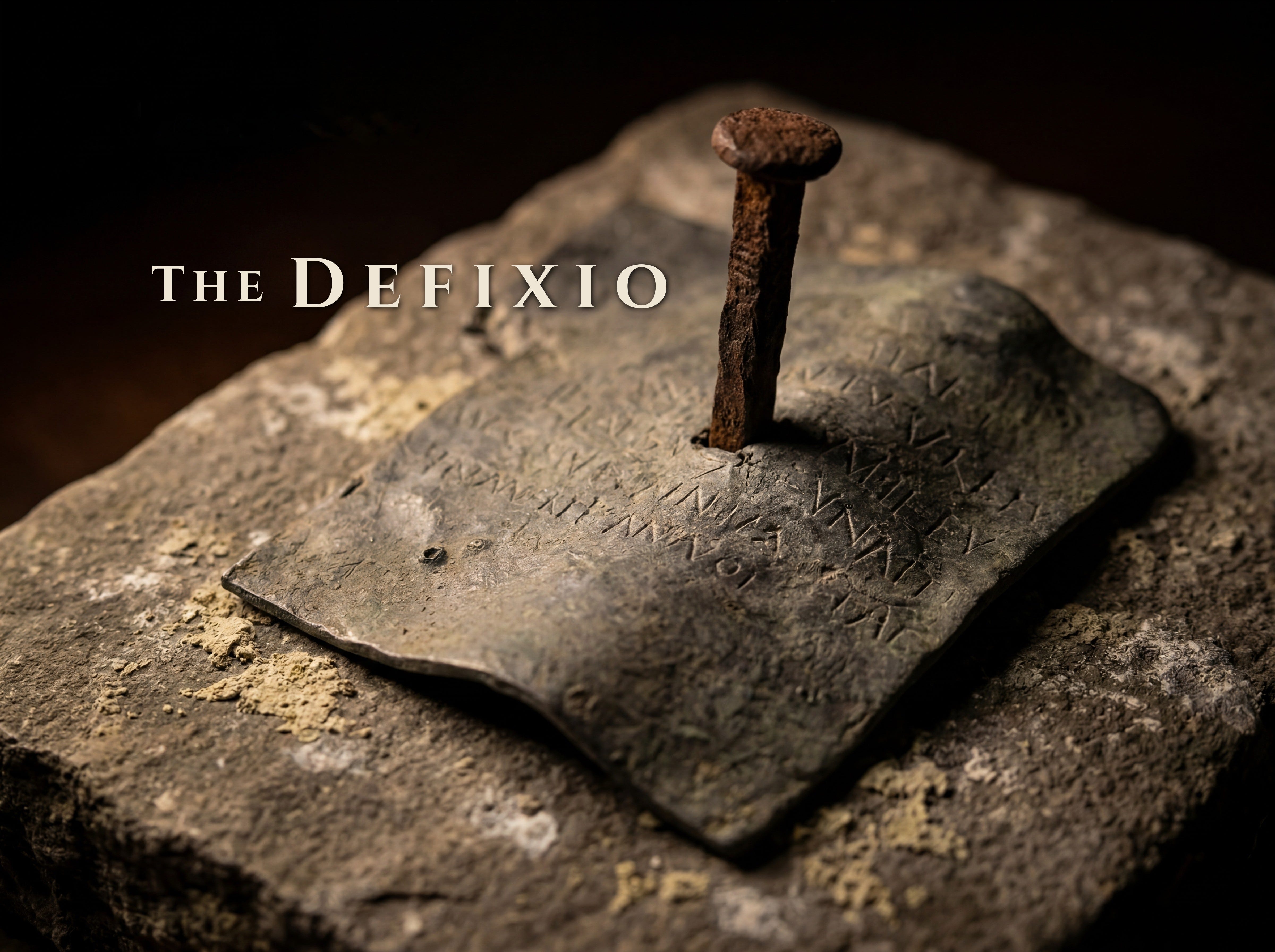

Chapter XI
The next night, Zoilos entered Brica’s tavern through the alley door, counting the angle of each footstep to avoid the boards that squeaked. He did not want to announce himself before seeing the room as it was. Inside, the air lay close and unmoved, the usual ferment arrested by drought and the habit of low voices. The crowd was thin: two loggers with jaws bruised from a brawl, a pair of old women dicing with barley grains, a squad of Batavians drinking slowly, as if measuring their time to the next assignment.
Brica presided behind the counter, sorting coins and shards of glass. Her hands were raw at the knuckles, a bandage black with hops around her left thumb. She did not look up as Zoilos approached. The candle guttered in its ring, making her face oscillate between shadow and flare.
He set the folded slip of paper—cedar fiber pressed inside—on the bar. Brica kept her hands at work.
Zoilos said, “It is not from here. Not from any place within a thousand stadia.”
Brica set aside the glass and wiped her palm on the apron. She peeled the slip open. With her thumbnail, she scraped at the cedar and held it to her tongue. Her face remained the color of straw. She flicked her eyes at Zoilos, then at the Batavian squad, then at the clock above the door.
“Tell it quick,” she said. “I close in twenty.”
He glanced at the loggers. Both were asleep, heads on arms, snoring into their own breath. The Batavians watched the cup, not the room. The women had gone.
Zoilos said, “I need the truth of what was buried.”
Brica gave a single nod. “You have the bones already. Is it not enough?”
He did not answer.
She reached beneath the bar and brought up a cup, half-filled with dregs. She drank it, then set it down beside the cedar. “He was my nephew. Musa,” she said, not hiding the word in accent or allusion. “The boy. My sister’s son.”
She continued, “He was born in Africa. Sabratha. His father was cavalry. Mauri, proper. The boy was a guarantee.” She shrugged. “If the father ran, the boy paid. When the father died of camp fever, they sent Musa north. He was six. He knew Latin, some Greek, could ride a mule and keep a ledger.”
She looked at the cedar fiber, turning it in the lamplight. “They made a joke of it, the officers. ‘The little accountant.’ They let him run the errands—sweeping, fetching, numbers. He was harmless.” She paused. “Until the old commander decided to settle the debts.”
Zoilos said, “Senilis.”
“Yes.”
Brica traced a circle on the bar with the rim of the cup. “They moved the boy. Sold him on a consignment to a slave-train. The men who took him were drunk. They beat him too loud, and the noise spread. The next day, the child was gone. No one saw him leave. No one asked.”
She drew a breath. “I asked. I walked the ditches, the grain room, the hollow under the baths. I found his shoe, once. I burned it, so the mice would not get at it.” Her voice did not quaver.
Zoilos watched her hands. The cut at the thumb, the whorls of flour on the nail beds. She wiped the bar clean with a rag, then held the cedar to her nose, as if committing the scent.
“I tried to pay for him,” she said. “They laughed. I never saw the coin again.”
He reached into his satchel, drew out the cylinder of lead, and placed it on the bar. The nail through its center was black with oxidation, the rim dented where he had pried it from the lime. Brica’s face went so still he wondered if she had recognized it instantly, or if she was refusing to see.
He rolled it closer. “Found buried with his remains.”
Brica did not touch it. She reached instead to the shelf behind her, and from between two bottles, drew a short, white object: a knucklebone, smoothed by years of handling. A child’s toy, shaped with primitive care, one side flattened, the other still showing the natural ridges.
She set it on the bar, directly beside the lead scroll. “He would spin it,” she said, “when I was grinding the mash. If it landed upright, he’d say it was a sign.” She looked at Zoilos, the light deepening the lines in her face. “He did not get many good signs.”
Zoilos felt his own hands go cold at the wrist. He tried to flex them, but the sensation lagged, as if the joints were packed with resin.
Brica drew the knucklebone to her palm, turned it three times, then set it spinning on the countertop. It wobbled, then toppled, stopped with the flat side up. She snorted.
“He would hide under the vats when it rained,” she said. “He said the world sounded better, when the copper shook.” She slid the bone across the bar, as if inviting Zoilos to test its weight.
He did not touch it. He kept his attention on the lead scroll.
“I could not read it,” he said. “It is written in reverse, I believe.”
Brica reached below the bar again, this time producing a sheet of beaten lead, blank but for a single score-mark. She placed it next to the scroll, then picked up a stub of charcoal and wrote on the sheet—her hand slow but practiced, the letters upright and clear.
She showed it to him. The name, incised with such force the letters puckered the metal: M U S A. Then a line in Brittonic, the sound-value of which was “may you find justice in the next world, where the laws run straight.”
Brica set down the tablet, then pressed the bone toy into the palm of her hand, closing her fingers around it.
“He was buried under the floor,” she said. “Not so he would be forgotten, but so he could never leave.” She said it the way one reports a weather front.
A silence spread, slow as molasses. The Batavian squad had finished their round and gone. The loggers slept. The only sound was the drip of yeast-cure from the fermentation pails, slow and arrhythmic.
Zoilos reached for the lead scroll, but Brica stopped him with a look. “Leave it,” she said. “If you take it, it is another debt you will never clear.”
He left it. He watched Brica replace the knucklebone behind the bar, placing it on a shelf alongside a row of broken amulets, each one burned or chipped. She closed the shelf with a click.
“Does it help?” Zoilos asked.
Brica did not answer. She wiped the rim of the cup, then folded the rag and set it at her elbow.
He stood, counted out three coins for the drink he never took, and placed them on the counter.
At the door, he paused. The air was thinner out here, the scent of yeast giving way to the sharper edge of parched grass. Behind him, Brica’s posture did not change. Her head was down, her hands idle.
He waited to see if she would look up, but she did not.
The evidence remained on the bar: the slip of cedar, the blank lead, the scroll. All visible, all indexed to a single name.
The door closed behind him, and the tavern’s warmth cut off like a hand withdrawn. The alley was dark and narrow, the walls pressing close, and the air carried nothing but the mineral smell of the drought. His legs moved him forward without instruction. The name was in his chest now, not his mind, and it sat there with a weight that his breathing could not shift.
He walked the length of the via principalis. The reasoning assembled itself with the speed of a clinical assessment. He had brought the evidence. He had named the boy. He had set the cedar and the blank lead and the cylinder before Brica in turn, and she had received them without breaking. The case, for the night, was discharged. He should return to his quarters and get some sleep, he told himself.
He turned at the south gate and walked the length of the via principalis a second time, in the other direction. Halfway along this second leg, where a doorway on the far side of the roadway caught a thin edge of brazier-light, a figure stepped out of the deeper shadow and crossed the weak circle of illumination. Short, dark, with the small drag at the right foot he had noted on the parade ground days before, in daylight. The figure did not look at him. It was moving with the rhythm of a man on a circuit. Zoilos filed the observation beside the earlier one and kept walking.
By the second pass, the reasoning had begun to fail him. Brica had reached beneath her bar and produced a sheet of lead in the same easy motion with which other women produce a knife or a coin. She had inscribed the boy’s name on it with a hand that knew the medium. The defixio still lay on her counter, unread; the one piece of evidence she alone in the fort might unbind, and he had walked away from it because she had told him to leave it.
He turned back.
The tavern’s lights had gone low, but Brica stood at the bar, back turned, arms folded. The knucklebone sat in the hollow of her left palm. She rolled it in small circles, worrying the edge with her thumb.
When she turned, her face was rearranged: every muscle set, her jaw so tense the cord stood out in the shadow. “You come again,” she said.
Zoilos did not waste the preamble. “I need it read,” he said.
Brica hesitated for only a moment. Zoilos thought that she would protest, but he was surprised when she instead brought up the lead scroll from behind her counter, inspecting the crimp at the end, the milled band where the nail passed through. She wiped the grime with the edge of her apron. The scroll’s surface caught the light, a spidering of reversed script in channels so deep the lead was nearly split. She ran the tip of her nail along the first line, then squinted, lips pursed.
“Need a mirror,” she said. She reached below the bar, brought up a disk of polished bronze, the back engraved with the remains of a trade mark: a ship, and a set of scales. She set the disk upright against a mug. In its reflection, the script reversed again, becoming briefly legible.
Brica’s eyes flicked, left to right. She spoke, almost inaudible, as she decoded the letters. “Curse against the betrayer, the liar, the debt-keeper. Musa, lost. Let the earth hold the secret.” Her finger stopped at the deepest cut in the tablet: the name gouged so hard it buckled the strip.
She looked at Zoilos. “You see? They killed him twice.”
He did not respond. He waited as she lined up the scroll and the blank, lead sheet. She held them side by side, then rotated both to show the matching nail-holes. “I found them,” she said. “Seven total. One for each day he was missing. Whoever buried him made them—rolled the lead, punched the holes, scratched the curses. This one seems to be number six.” She tapped the blank sheet. “The last is empty. No name.”
Brica set the scroll in his hand. “You understand? The child was a ledger entry. When they lost him, they erased the record, but the debt stayed.” She nodded at the bone toy. “That’s how the world remembers. Not by law.”
He tried to steady the scroll, but his hand shook, just at the knuckle. The movement was involuntary, impossible to disguise. He steadied it against the bar. The sensation in his palm was weightless and crushing, the contradiction a pulse in the wrist.
Brica’s gaze held him there. “When you bury a child under the floor, the ground itself sickens,” she said. “You have seen it. The wards, the block. The fever never left after Musa. It has plagued this place.”
Zoilos wanted to argue. He marshaled a line of logic, but the words refused the air. Instead, he studied the surface of the mirror, where his own face hung beside the tablet. It was no longer the face of a distant examiner, but something colorless, a skin draped on a counting frame.
Brica wiped her hands, then set both palms flat on the bar. “You have what you need,” she said. “It is all the evidence there will be.”
He could not move for a time.
When he did, he took the scroll and pressed it flat, aligning it with the margin of his book. He folded it into the page, then closed the book, index finger marking the place.
He said, “I will remember the name.”
Brica looked at him. Her eyes were not wet, nor was there any quaver to her voice. “You will not forget,” she said. “It is the only way they lose.”
She replaced the bone toy on the shelf, lining it up with the others. The motion was deliberate, no flourish, just the return of matter to where it belonged.
Zoilos left the tavern. The night air was dry and carried nothing. He felt the scroll in his pocket, cold and pliant, the name inside cutting every step.
The lights of the fort shone dull through the haze. The road was bare. He walked, counting the uneven stones.