
The Defixio: Chapter III
Ghosts in the Mud


Chapter Navigation:
Chapter III
The air inside the praetorium pressed with the density of three bodies for every one present. Zoilos entered at the second bell, as summoned, in the sweat-stiffened tunic and the boots he’d worn in the sump. He passed through the vestibule, where two junior officers in matching civilian whites bracketed the entrance, and into the administrative sanctum.
The oil lamps had been lit despite the hour, their flames low and orange against the whitewashed walls, throwing shadows that moved when no one did. The shutters were drawn. What little daylight seeped through the slats fell in thin bars across the floor, catching the dust that rose from Zoilos’s boots with each step. The Crocodile Table occupied the center of the room like a body on a bier, its lacquered green backs catching the lamplight and holding it. The air tasted of camphor and rose-oil and, beneath both, the sour note of a man who had been sweating in a closed room and perfuming over it.
Terentianus waited by the Crocodile Table, standing, arms folded above the lacquered green backs of the Nile monsters. Not a seat in sight: not at the table, not on the marble bench beneath the window, not even the low stool used by the typist. The only open surface was the stone floor, an invitation to kneel that Zoilos would rather be flogged for rather than accept.
“Medicus,” Terentianus said, voice stripped of salutation, “your report, if you please.” He kept his eyes on the table, as if unwilling to commit Zoilos’s existence to memory.
Zoilos advanced, diploma clutched in one hand, wax tablet in the other. He kept a fixed pace, calculated to neither defer nor offend. He stopped just short of the table’s edge, close enough to smell the camphor polish and, underneath, the milder rot of the marsh outside.
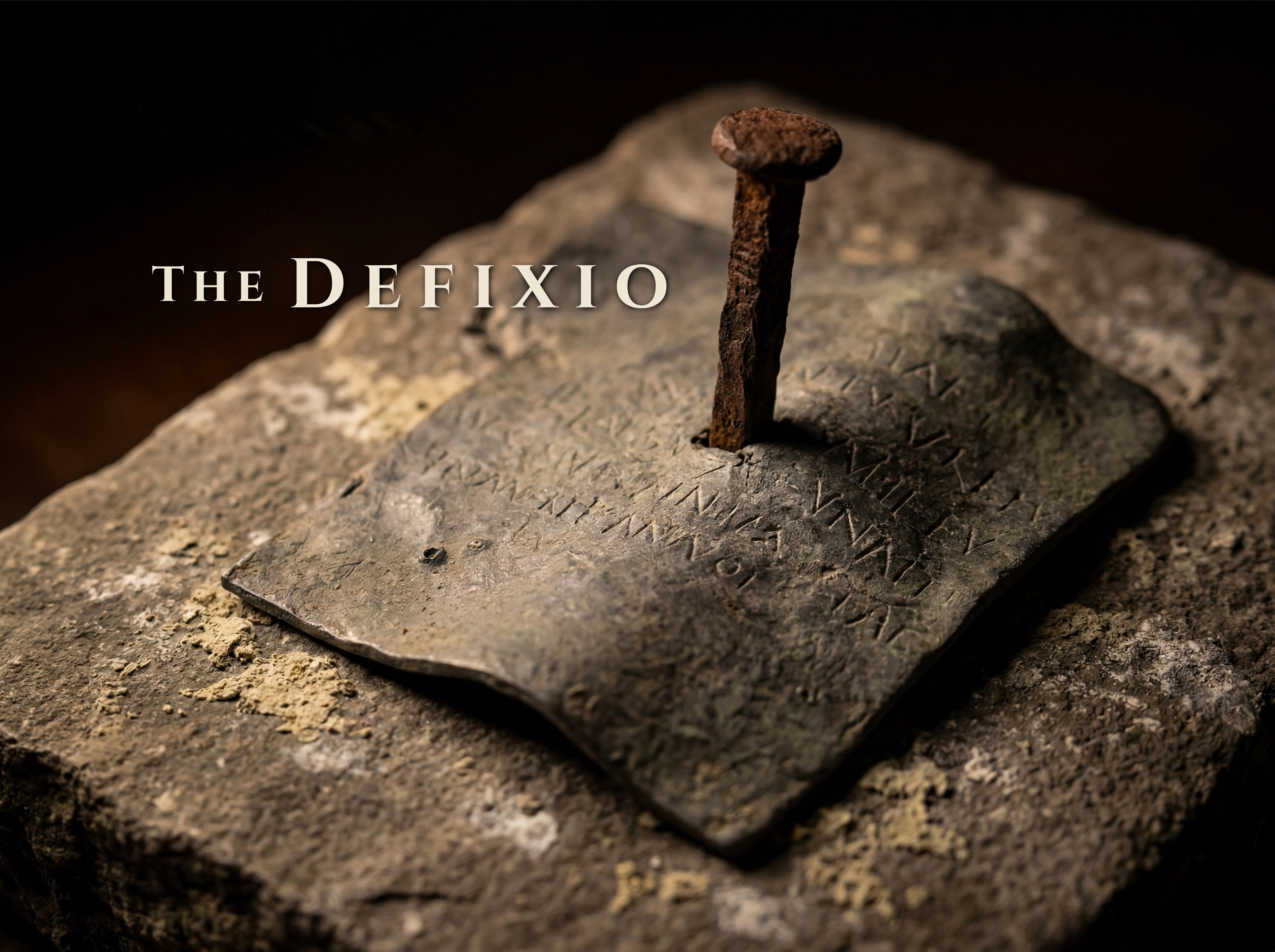
He drew a breath. “I found a child’s skeleton under the floor of Block IV. The body was deliberately placed there—packed in hydraulic lime, surrounded by construction timber. Whoever buried this child took care to preserve the remains. There was a lead scroll and an iron nail with the body, along with cedar fragments that are not native to Britannia. This was no accident. Someone wanted this child hidden but intact.”
Terentianus did not look up. Instead, he turned to the glass amphora at his left and poured a finger-width of clear liquid into a cup so thin it trembled with the movement. He sipped. He replaced the cup on the crocodile’s open mouth and patted the head as if rewarding a hound.
“Is this an interruption of function, or a curiosity?” Terentianus asked. “The men are superstitious; I require the medical verdict.”
“The men are justified,” Zoilos said. “The burial is not Roman law. The act itself is a deliberate criminality, covered by expertise and means. I have isolated the cavity; the risk of further contagion is minimized, provided the block is kept clear.”
Terentianus finally met his gaze. “You imply malice, or is this mere procedural excess?”
Zoilos’s pulse ticked at his jaw. “I state only the evidence. The child was not local. The methods—materials—suggest access to imported goods. The resources used could not be justified for a casual disposal.”
A flicker, almost an eyebrow raise. Terentianus set down his cup and produced a tiny cut-glass vial from his sleeve. He twisted the lid, dabbed the oil onto his left wrist, then the right, then both sides of his neck. The scent cut through the room: rose, but with a bottom note of cured hide. He closed his eyes for a moment, breathing it in.
“The last prefect,” Terentianus said, “purchased a dozen such vials from a Jew in Ephesus. Guaranteed to repel any provincial odor. And, incidentally, any boredom with life. Have you ever been to Ephesus, medicus?”
Zoilos said nothing.
“I recommend the market. You’ll find the city less impressive than the perfume, but that is the nature of commerce.” Terentianus rolled the vial across his knuckles, capped it, set it beside the amphora.
“The fate of the child’s remains?” Zoilos asked, voice empty.
“Drainage problem, medicus. I’ll have the floor resealed.” Terentianus lifted a sheet of parchment, inspected the blankness, and then let it fall to the table. “You may go.”
Zoilos did not move. “There is also the matter of the lead scroll. The script is not known to me, nor to Barsamias. The nurse believes it is an occultum, a binding curse.”
Terentianus shrugged with the fluency of one for whom nothing is new. “All outposts have their ghosts, their superstitions, their little dramas. My recommendation is to burn the scroll and say nothing. Or, if you prefer, send it with the next diplomatic pouch to Londinium, where it will be catalogued and then lost. Either way, the story ends here.”
The silence bricked the room. Zoilos felt the Crocodile Table’s painted eyes level with his shins.
“I will do as required,” he said.
Terentianus smiled then, a short technical gesture. “Surely a man of your… dedication… understands that we must focus on what truly matters? The living, not these little mysteries in the mud?”
He lingered on the word “living” as if offering a morsel to a well-trained dog.
Zoilos nodded once, then turned. The weight of his own bones in his body suddenly intrusive; he walked out without a backward glance.
Zoilos entered the records alcove before the hour of first inventory, catching the torchboy in the act of sleep at the foot of the shelves. He stepped over the prone body, careful not to touch flesh, and made for the archive at the rear.
The supply ledger sat on its shelf, wax surface scrubbed to an unmarked black. He thumbed through the pages, found the requisition log, and read the most recent entry. He blinked. Instead of his plea for clean water and sulfur, there was a single line:
“Valetudinarium requests Falernian wine, cask size standard, urgent, for convalescents. Approve immediately. Signed: Zoilos.”
The handwriting was his — at least the shape and flow. But the pressure was wrong. Each loop too regular, the baseline too neat. He stared at it for a full minute, uncertain if the error was in the tablet or his own mind. His hands had gone cold. He noticed this the way he noticed a patient’s hands going cold: as a symptom, a thing to be catalogued.
The torchlight moved across the wax surface and the forgery looked, for a moment, exactly like his own hand. The loops were right. The spacing was right. Only the pressure was wrong, and even that was close enough to make him doubt his own memory.
He set the tablet down and pressed his palms flat against the shelf. The wood was real. The grain was real. The marks his stylus had gouged into the backboard yesterday were real. He held on to these facts the way a man in deep water holds on to the shape of the shore. He had written nothing of wine, never in his life used the word “convalescents” in any context but derision.
Someone had erased his words and written new ones. Someone with access to the records. Someone who wanted him discredited.
It took another minute before he noticed the faint ghost of his own stylus, visible only when the wax was tilted just so. He angled the tablet toward the torchlight, angling it until the surface caught the flame at a shallow grade. There — faint pressure shadows, the ghost of his original handwriting beneath the smoothed wax. The strokes were unmistakable: the upward slant of his alpha, the cramped spacing he used for urgent requisitions. Someone had scraped the wax flat and rewritten the entry, but the wooden backboard remembered the pressure of the original stylus.
He did not touch it. He closed the ledger, set it back in its slot, and let his hand fall to his side.
He returned to his quarters. The room was barely wide enough for the cot and the shelf of medical texts; the window faced the grain store wall, so the light was always filtered. His diploma hung crookedly from the nail.
Zoilos sat on the cot and studied it. The ink had faded since the day of issue, Pergamon’s seal gone soft at the edges. He tried to remember the weight of the hand that had first pressed it into his palm.
The nausea arrived without warning. Not the slow-building kind he knew from the wards but the sudden, vertical kind, as if the floor had dropped six inches and his stomach had not followed. The diploma was still on the wall. The seal was still legible. None of it had changed. But the distance between what the parchment claimed and what the wax tablet now said about him had opened a gap his eyes could not close. He pressed the heel of his hand against his sternum and breathed through his teeth until the room stopped tilting.
He could not touch the parchment. His fingers hovered, and the nausea crawled up his throat, sour as the water in the cistern.
He stood, turned from the wall, and left the diploma hanging. The only sound was the faint scuffing of the torchboy sweeping the hall, the rhythm as indifferent as breath.
Zoilos found Barsamias at the edge of the barracks yard, hunched over the shallow trench that yesterday had yielded the child’s skull. The earth had been heaped back over the opening; only a trace of white lime, thin as the powder on a miller’s hands, lingered at the rim.
“Where is Hulderic?” Zoilos asked, scanning the work detail for the familiar shaved head. He saw nothing but the usual shuffle of Batavian and Illyrian labor, none with the Batavian’s height or the old scar at the jaw.
Barsamias barely looked up. “Gone,” he said. “Left before first light. Orders came late—transferred to the peat post. No notice.”
Peat post. Two days’ ride north, beyond the Wall. Zoilos’s jaw tightened, but he said nothing. “Was he given leave to pack?”
“None. Message from the command office—move at once.” Barsamias spat into the grass, wiped his hands on his tunic.
Zoilos let the fact stand, unchallenged. He made his way to the records office, where a fresh roster had already replaced the previous day’s. Hulderic’s name was gone, replaced by a new Batavian, unfamiliar. The handwriting was careful, the ink still tacky to the touch. Zoilos wondered whether the prefect wrote the update himself, or if the task was considered too menial even for that.
Beneath the roster, the transfer slip itself still lay in the pinned stack on the desk. Zoilos lifted the edge with one finger. Hulderic’s name, struck through with a single clean line. Below the strike, the authorizing signature in older ink, the loops heavy and square — the pressure of a man who wrote as though cutting wood. P. MASCLUS. Zoilos read the name twice, then let the slip settle back into place.
He signed the log and walked to the medical ward, passing the stench of the marsh that had somehow grown stronger overnight. The patients were unchanged: the same faces, the same animal moans, the same dull submission to the protocols of Empire. He saw them, every one, but they did not see him.
In the alcove, Zoilos took up the brush and scrubbed the sink for twenty minutes, though the stains would not lift. When Barsamias joined him, he did not pause or look up.
Zoilos set the brush down and dried his hands on the cloth at his hip. He spoke in Greek, low enough that the patients in the corridor would hear only the cadence. “The fort is sick,” he said. “Not in the way they think.”
Barsamias watched the water pool and then soak into the stone. The ward sounds filtered through the wall: the coughing, the scrape of a basin, the low murmur of a man talking to no one. Barsamias had not moved. His hands were still wet from the sink, and the water dripped from his fingertips onto the stone floor in a rhythm that was almost regular. He stood close enough that Zoilos could smell the vinegar on his sleeves. Neither of them had stepped back. “Then the bones—?”
“Pus,” said Zoilos, “to be drained and buried. Until the next swelling.”
Neither spoke for a long time. The patients in the ward resumed their moaning, as if the cycle had already begun again.
At dusk, Zoilos stood in the corner of the valetudinarium, staring through the warped glass of the eastern window. He saw a line of soldiers carrying flagstones, one by one, to Block IV. Each stone was fresh-cut and chalky, the mortar laid in thick ridges. He watched as they tamped the earth, pressed the stone flush, then swept the seam with a brush.
No one looked at the sky. No one paused to spit or to scratch.
When the last stone was set, the men walked away in line, their boots leaving perfect, uniform prints in the wet clay.