
The Continuity Problem Nobody Warns You About
And the tracking system I built to fix it.


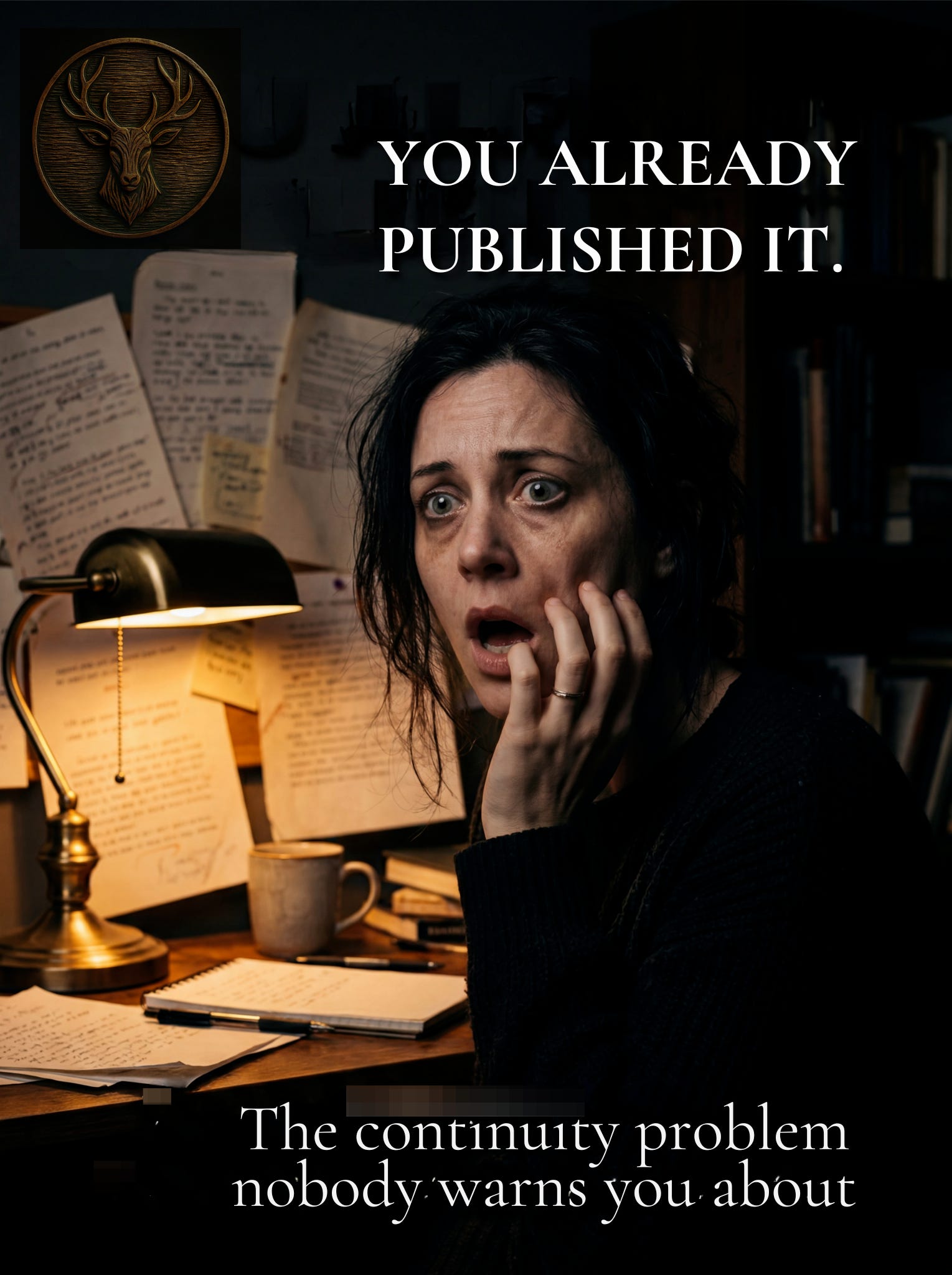
There’s a specific kind of dread that has nothing to do with the story you’re writing and everything to do with the story you’ve already published.
It happens around chapter twelve. Maybe chapter fifteen. You’re drafting a scene and a character says something that references an event from six chapters ago — and you stop. Because you can’t remember if that event happened the way you’re describing it. You open the earlier chapter. You scan. And there it is: a contradiction. Not a huge one. But the kind a reader will catch. The kind that makes someone leave a comment that starts with Actually…🙄
If you write serialized fiction — publishing chapter by chapter, week by week, on Substack or Royal Road or anywhere else — you know this feeling. And you know the worst part: you can’t go back. The chapter is live. It’s canon now. Your readers are holding you to it whether you remember planting that detail or not.
Traditional novel-writing has a safety net. You draft the whole thing, then revise. You catch the contradictions in editing. Serialized fiction doesn’t give you that luxury. Every chapter you publish is a binding contract with your reader. Every planted clue, every supernatural rule, every injury a character sustains — those are promises. And the longer your story runs, the harder it becomes to keep track of what you’ve promised.
———
It’s Not Your Prose That Breaks. It’s Your Memory.
Here’s the thing nobody talks about in craft discussions: most serialized stories don’t fail because the writing gets worse. They fail because the writer’s recall gets worse. The prose stays sharp, the scenes still land — but somewhere around the midpoint, the connective tissue starts to fray.
A motif you planted in chapter two quietly dies on the vine because you forgot it existed. A character knows something they couldn’t possibly know yet, because you lost track of who was in the room when the information was revealed. A rule you established about how your magic system works gets bent in chapter fourteen because you didn’t write it down as a constraint — you just held it in your head. And heads are unreliable.
Spreadsheets exist, sure. But most of them track the wrong things. They track plot — what happens in each chapter. And plot is the easy part. The failures that actually erode reader trust are failures of continuity: the atmosphere that stops evolving, the knowledge asymmetry between characters that collapses because you forgot who knows what, the world-rule you violated without realizing it, the orphaned promise your reader is still waiting on.
I know because I’ve made every single one of these mistakes.
———
So I Built Something.
Over the last year, as my own serialized work got longer and more structurally complex, I started building a tracking system. Not a plot outline — I had that. What I needed was a way to track the promises my story was making to the reader, and the constraints those promises created for me as a writer.
The result is a six-tab Excel workbook called the Lore & Motif Continuity Tracker. Each tab handles a different dimension of continuity. You don’t have to use all six — pick the ones that match your story. But here’s what they do:
Tab 1 — The Grimoire of Motifs. Tracks every recurring image, symbol, sound, or sensation in your story. When it first appears. How it changes. Where it echoes. What it needs to resolve into. Because a motif that never pays off isn’t atmosphere — it’s a broken promise.
Tab 2 — The Chronicle of World Rules. Every rule your story establishes — magic systems, supernatural limits, technology constraints, political structures — stated as a clean declarative sentence, with a column that forces you to answer: what does this rule prevent me from doing? That constraint column has saved me more times than I can count.
Tab 3 — The Character Dossier. Logs each character’s physical state, knowledge state, emotional arc position, and exposure to your story’s central threat — updated at every chapter boundary. The goal is simple: never let a character be in the wrong place, know the wrong thing, or heal from an injury too fast.
Tab 4 — The Timeline Reliquary. Locks your story’s chronology using in-world dating. Every event gets a timestamp, a list of who was present, and a note about what timing dependencies it creates. If your story spans more than a few days, this tab is the difference between a tight narrative and a timeline that quietly collapses under scrutiny.
Tab 5 — The Orphan Registry. This is the one that keeps me honest. Every planted detail, seeded image, or foreshadowed element that hasn’t been paid off yet — logged with a priority level. Anything marked CRITICAL is a promise the reader is actively waiting on. Before I draft a new chapter, I read this tab first. It’s the single best defense against the dropped thread.
Tab 6 — The Transmission Log. For stories with a spreading element — supernatural contagion, political corruption, psychic awakening, alien infection. Tracks who’s been exposed, by what vector, what symptoms they’re showing, and how far along they are. If your story involves any kind of escalating influence moving through your cast, this tab keeps the progression honest.
———
Every tab is self-contained. Every tab has its own instructions, column guides, and worked examples so you can see the level of detail that actually helps. You delete the examples, start with your own entries, and build from there.
I’m sharing the full workbook with paid subscribers below, because this community is the reason I kept refining it. If it catches even one dropped thread for you, it was worth sharing.
How I Actually Use This
A few practical notes before you download it, because I’d rather you use it well than just have it sitting in a folder.
I don’t fill in every tab. For one project I might only need the Grimoire of Motifs and the Orphan Registry. For another — one with a large cast and parallel timelines — I’m living in the Character Dossier and the Timeline Reliquary. The tracker is modular. Use what your story demands.
I update it after drafting, not during. The creative flow comes first. Once a chapter is drafted, I spend ten to fifteen minutes updating the relevant tabs. That’s where I catch things: a motif I used without realizing it, a rule I bent, a character who now knows something that creates a problem for a later scene.
The constraint columns are the most valuable part. In the Chronicle of World Rules, the column labeled “Constraints It Creates” forces you to think about what you’ve locked yourself out of. That’s the column that prevents the violations before they happen. In the Orphan Registry, the priority system does the same thing — it forces you to triage your own promises.
I read the Orphan Registry before every chapter. Not to force a payoff into a scene that doesn’t want one — but to keep the open threads in my peripheral vision. Sometimes a scene I’m drafting is the natural home for a resolution I’d forgotten about. That only happens if I’ve scanned the list recently.
———
The Download
The full workbook is attached to this post as a .xlsx file. Open it in Excel, Google Sheets, or any spreadsheet app. Each tab has its own instructions at the top — read those before you start.
