
I Deleted 400 Subscribers. Then Something Strange Happened.
What happens when you stop performing for a metric that was never real.

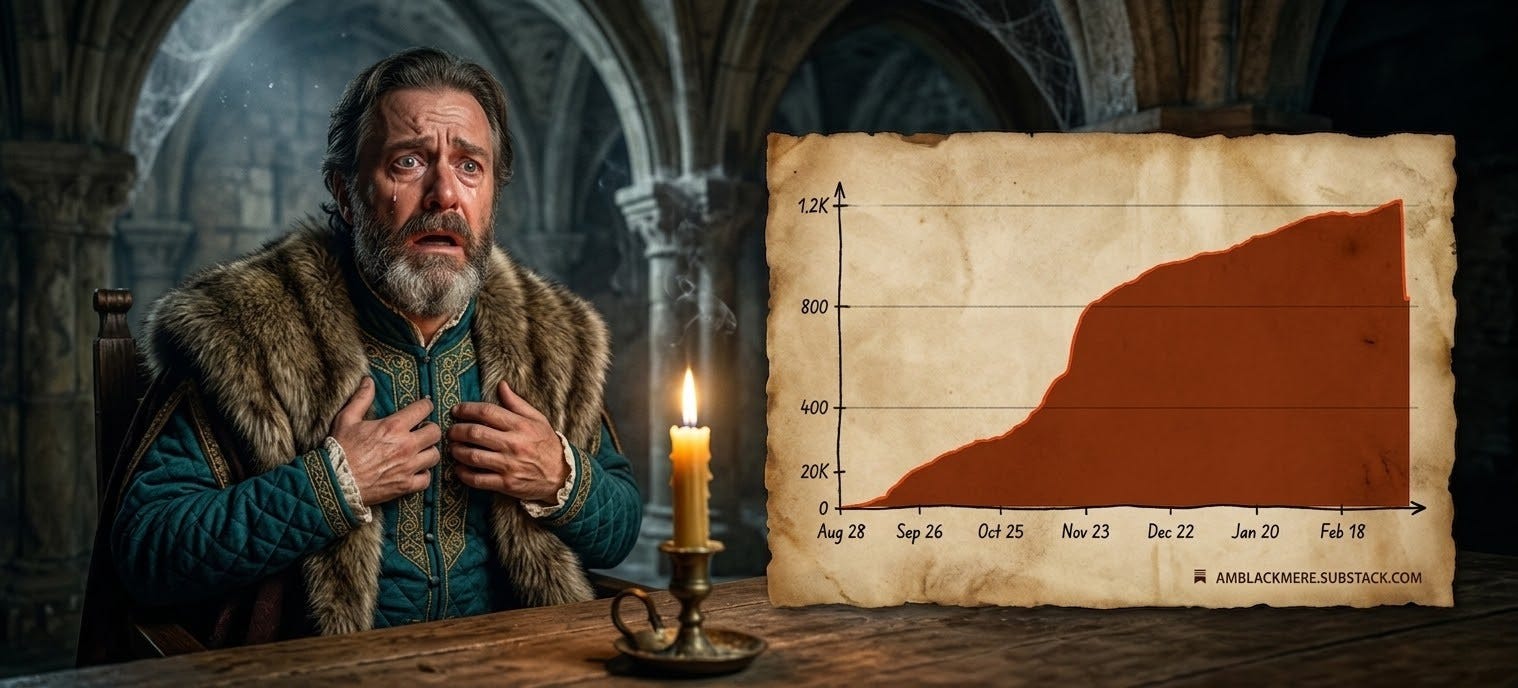

The number was 400.
I knew which ones they were before I started. I had the data. Zero opens over ninety days. No clicks. No replies. Some of them had never opened a single email. They were there in the way that old mail piles up on a counter: technically present, filed, forgotten.
I kept them anyway. For months.
What finally moved me wasn’t a strategy.
The honest answer is that I got tired of performing for a number that wasn’t real.
A subscriber count is the most visible metric you have on Substack. It’s the one people notice. The one that gets screenshotted for milestones. For a long time I understood it, intellectually, to be a vanity number. I told myself I wasn’t attached to it.
I was wrong.
What actually moved me was learning about deliverability. Specifically: that an inactive list isn’t a neutral, harmless thing you simply carry around. It creates friction. Not in a vague, algorithmic sense. In a concrete one. The people who actually open things, who actually read, who actually respond... their experience is measurably degraded by the presence of all those silent addresses. The signal gets muddied. The feedback loop breaks down. You stop learning who your actual readers are because the data is full of people who aren’t reading anything.
That felt like a betrayal I hadn’t intended, but was committing anyway.
Here’s the thing about knowing something is the right call: it doesn’t make it easy.
I stared at the removal function for longer than I’d like to admit. My brain kept running through a version of events where one of those 400 was about to open the next email. Where someone who had gone quiet for six months was on the verge of coming back. Where the number I was about to delete was, in some meaningful sense, real.
It isn’t a rational fear. I knew that. But there is something about a number that reads like a person. You built something, you put it out into the world, and 400 people said, at some point: yes. Even if they never said anything again. Even if they had long since left their inboxes and moved on entirely.
Deleting feels like undoing.
What I had to remind myself was this: they had already left. I was just the last to acknowledge it.
I hit confirm. Then I sat back and waited to feel something bad.
It didn’t come.
What came instead was something closer to clarity. The list I was looking at was now real. The numbers were honest. I knew that the people remaining had actually been here, actually opened something, actually made a choice to stay. No dead weight. No noise in the ledger.
The dissonance I had been bracing for turned out to be entirely anticipatory. The anxiety lived in the approach, not the aftermath. Once the decision was made, it dissolved almost immediately. What had felt like loss, from the outside, had been dragging on me quietly for a long time. Releasing it felt like setting down something I hadn’t realized I was carrying.
Within a few hours, my Notes started performing differently.
Not dramatically. But noticeably. Reach on a new Note I posted the same morning was measurably higher than comparable Notes from the week before. Engagement within the Substack ecosystem felt cleaner. More responsive.
It wasn’t my imagination. The metrics confirmed it over the next 24 hours.
Here’s my best theory on why.
Substack’s internal discovery system doesn’t care how many subscribers you have. It cares how engaged they are. The platform makes recommendations, surfaces Notes in feeds, and distributes content based on signals: who opens, who restacks, who replies. These signals are ratios. They are percentages.
When 400 addresses that never open anything are sitting in your list, they drag your engagement rate down. Not invisibly. They are dead weight on every signal calculation the algorithm performs. Your open rate looks lower than it is. Your click-through rate looks worse than it is. Your list looks, to the system, like it belongs to a publication that people tolerate rather than one they actively seek out.
Remove them, and the ratio becomes honest. The algorithm looks at your list and sees a publication where a meaningful percentage of subscribers actually engage. That changes how it treats you. It changes where your content surfaces, who gets recommended to follow you, how your Notes circulate.
The list I had was larger. The list I have now is legible to the system in a way the old one wasn’t.
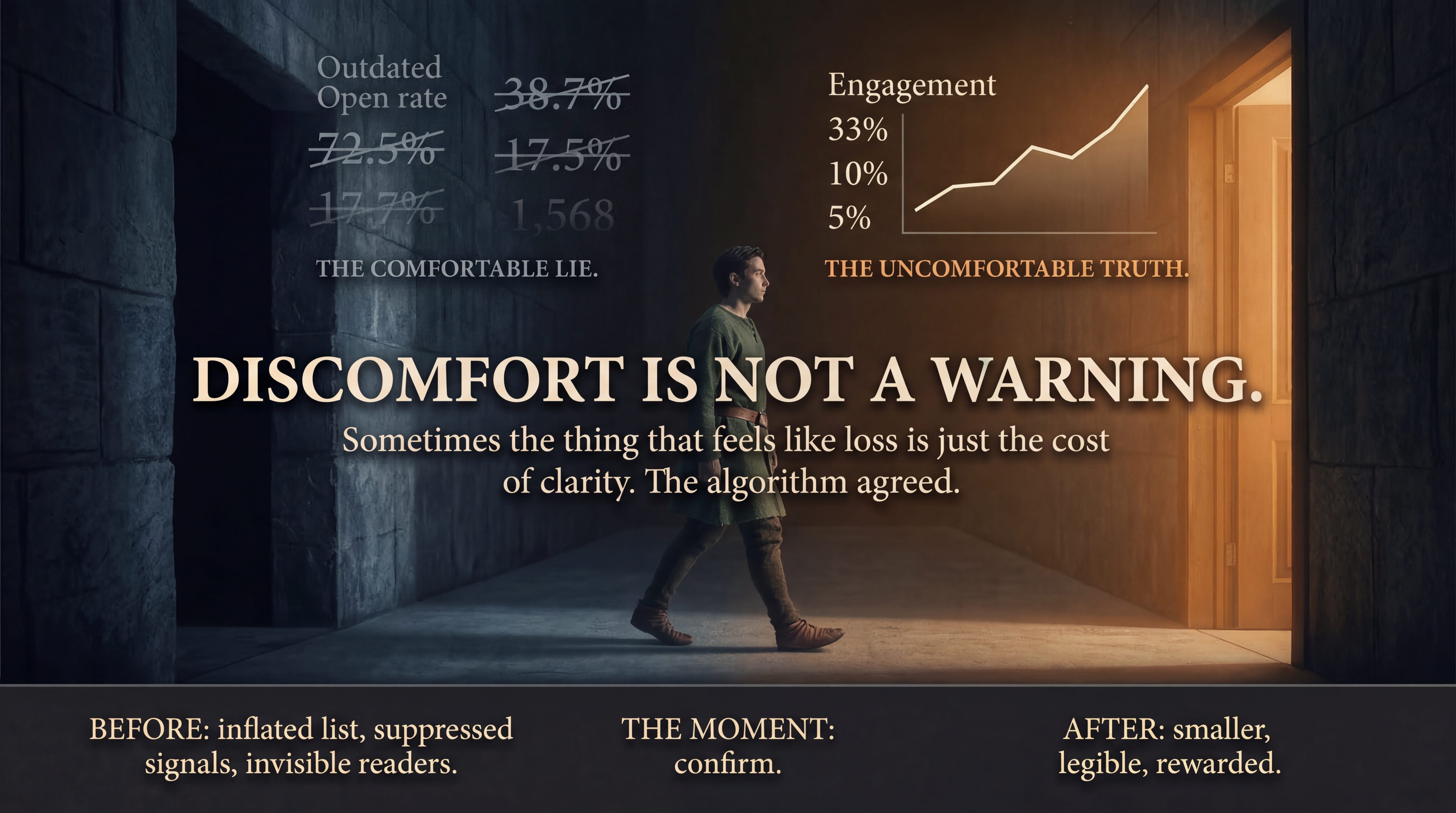
There’s a broader lesson here, and it’s one I keep running into in different forms. The vanity of a large number isn’t just psychological. It’s a technical liability. Inflation corrupts the signal. And the platform responds to signal, not sentiment.
Clean. Real. Smaller, maybe.
That’s where I’m building from.
I had a moment in my life that I didn't have my next move planned. I liked plans. So that moment was terrifying.
That's when I started living by, "if it scares me, it's probably worth doing."
*This does not include reckless/dangerous acts*
I’ve had my own finger poised over that delete button several times, and always pulled back for the emotional reasons you so eloquently name.