
Bring Forth the Silent Children
A Dark Reimagining of the Pied Piper Legend

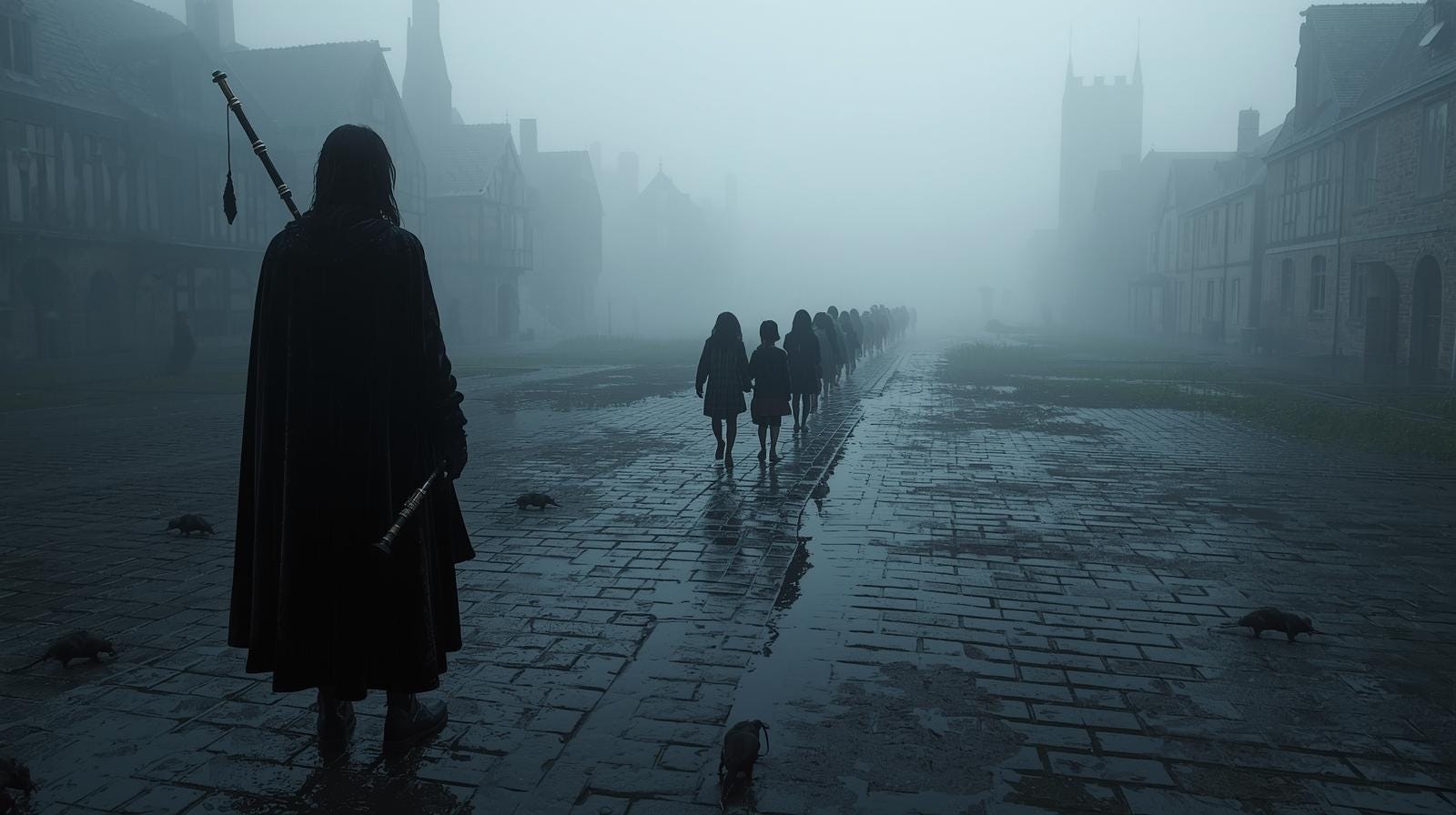
The piper’s cloak clung to her ankles, sodden black velvet drinking the dregs of last night’s rain. She stood with one foot braced in the rut of the gutter, her chin tipped high, the flute’s bone-pale length pressed to her mouth. Fingers flickered along the polished holes, nimble as a conjurer’s, but the only music in the square was the wet hush of dawn and the shuffling, multitudinous padding of rat feet.
They came as if poured from a sack—the gaunt brown ones, the blunt-nosed piebalds, the pale-pink trembling kits with tails finer than a thread. The first rank slid through the muck and pooled around the piper’s boots, their bodies sluicing into a glossy, living tide that left the cobbles shining with oil and muck. The second rank followed, and the third, inexhaustible, streaming from between stones and through splintered cellar doors, emerging from the shattered jaw of a dead cat beneath the tanner’s awning. Eyes round and black and bead-bright, every head quivering to a silence only they could hear.
From above, in the shuttered windows of the apothecary, a woman watched, her face the color of candlestubs, wringing her hands as if she could throttle the piper’s tune at the source. Across the way, a child pressed both palms to the glass, breath fogging small, frantic ellipses, until a mother’s pale arm yanked her from sight. Here and there, merchants left off sweeping their stoops and stood in the mud, lips flattened white.
The piper did not glance up. Her lungs swelled, cheeks hollowed, fingers danced faster over the holes—all the motions of a deepening melody with no note to be heard—while her shoulders bowed against the thickening tide of rats now milling six deep around her calves.
There was a kind of awe then, a breathing-in of expectancy. In the doorways they gathered: the baker’s wife with her rolling pin clamped to her apron like a holy relic; the butcher, red-armed and sullen, jaw set for violence and eyes brittle with unease; even Old Dannel, the warden, pale as a thumbprint and half-dressed, clutching his nightshirt at the throat. Some crossed themselves, lips moving in frantic prayer, while others spat and made the horn-fingered ward against evil. Still the rats came, undulant, ceaseless, until the square’s stone was lost beneath them and the air sluiced with their musk.
On the far side of the square, a pair of the town’s broomsmen waited, faces set in the peculiar blankness of men who have lived too long beside calamity: they wore their worst boots, their faces wrapped in soiled kerchiefs, and their eyes fixed anywhere but on the piper herself. As the last of the rats funneled past, the broomsmen hustled down the alley, trailing the vermin as if shepherding a grotesque parade. Every morning was the same: the rats would be led beyond the town gates, to the river or the charred fields, and left to shudder into the wild or drown. Each evening, some few would find their way back, but never enough to require more than a soft jog of the piper’s head, never enough to keep her from her allotted circuit.
The townsfolk never paid her in words. When she passed, merchant windows sealed with a snap, customers ducked behind barrels and counters, and the smallest children pressed their hands over their ears as if even the ghost of her music might pull them from their beds at night. On Mondays, the baker left a clay loaf by the piper’s stoop—a fresh boule set atop a square of damp linen, always with a thumbprint pressed into the crust. On Fridays, a handful of coins rolled from the nurse’s broad palm into the piper’s own, the exchange silent but for the rattle of metal on skin. No one ever met her gaze.
Sometimes, the children played at being her: they snatched reeds from the marsh and postured in the road, whistling tunelessly and marching a line of beetles across the stones. Their mothers would seize them by the wrists and cuff their ears, muttering about the Devil’s tune, about mouths that summoned more than they could silence.
It was said, in the hush of candlelight, that the piper had once been a child herself, daughter of the old bellman, who drowned in silt for the town’s sake when the river turned to poison. It was said she ate nothing but the flesh of the rats, and that her tongue was a coiled pink worm, or that she had cut it out herself, a sacrifice for a life unburdened by sound. It was said, also, that her flute was not wood, nor bone, nor silver, but the hollowed femur of a monster, its music a hunger that could not be fed.
She never lingered among the living. At dusk, the piper would walk the length of the embankment, skirted by the thin mist that rose from the marshes, her shadow trailing long and dark over the water. There, she unrolled her mat beneath the wattle tree, and ate her bread, and wiped the crumbs from her lips with the hem of her sleeve. Sometimes, when the moon was bright, she would unstop the flute and run her fingers along the holes, tracing the gentle ridges like a prayer bead.
The first child to break from the crowd did so on a day without rats.
Every gutter lay empty, every doorstep clean; only mud clung to boots and the skirts of women who’d come to gawk. The ratcatcher stood in the drizzle, shoulders hunched, face set in that familiar scorn, flute poised but silent—mere pantomime of her famous tune. Beneath sagging awnings and spindly chestnuts, the townsfolk pressed in, their smirks sharp, as though by watching they could strip her of magic and reduce her to flesh and bone.
He was small—barely seven, his smock’s hood pulled low, hands curved as if cupping something no one else felt. When she began her slow, careless tonguing of the flute, the boy’s body shifted before his head moved. At first the villagers laughed—a burst of cruel relief that only she could answer the call of the lost song. But as her fingers danced, the boy’s own limbs obeyed without thought: ankles pivoted, knees bent, elbows tracing invisible arcs that mirrored her own precision.
A ripple of unease ran through the crowd. The ratcatcher faltered mid-gesture, her flute halting as though caught between breaths. From the dark corners of the square—hidden in alcoves and behind barrels—the faintest scurry answered them, a thousand tiny feet stilled by the sudden silence. The air vibrated, taut as a drumskin between two thumbs: the melody, they realized, was no longer hers alone.
He spun once, twice, in tight spirals timed to fingers she couldn’t move fast enough. Then he stopped. In that held moment, the rats—emerging like driftwood from the shadows—fixed their beady eyes on the boy instead of her. A collective shudder passed through them, their twitching whiskers suddenly still. Then, like water seeping into sand, they melted back into the crevices and gutters from which they’d come, leaving only the faintest rustling in their wake.
The townsfolk stood frozen, a tableau of half-raised arms and parted lips. Then a woman’s cry—half gasp, half curse—broke the spell, and they scattered into the now-empty streets. An eerie clarity settled over the square, as if the world had held its breath and found it easier than exhaling. The boy—barefoot, bewildered, his head tilted as though listening to the hush between thunderclaps—stood unclaimed at the square’s center. His mother, a woman with arms made wide by years of gathering, reached him last. Her voice tore the silence, then gutted itself, finding nothing left to claim.
The ratcatcher lowered her flute. Her gloves—patched with the hide of a hundred vermin—trembled against the shaft. She watched, and the boy watched her watching, a gaze that held neither accusation nor gratitude, just a species of knowing.
It was the second child who changed everything. She arrived with a crowd’s momentum: a girl with hair cropped short to show the ragged edges of both her ears, the left one folded upon itself like wet paper. At first, she lingered at the periphery, dipping her chin and miming the boy’s strange, precise movements. Then another joined—a third, a fourth—children neither kin nor classmates, joined only by the shared calamity of their unmoving eardrums, the way their laughter rattled in the skull and not the air.
No music played, but they moved as if it did. Each step copied the boy’s, each finger curl and shoulder swerve repeated in perfect, silent canon. It was the echo of a tune beneath hearing, the way thunder sometimes pressed its shape into the bones of old men before the clouds could be seen. The ratcatcher blinked hard, uncertain if this was disaster or deliverance.
The rats, for the first time, did not return. The gutters stayed clean; the cellars were nothing but the home of dust and dead spiders. Instead, every morning there were more children. They gathered at the square’s edge, forming ranks as the piper once had with her drowned orchestra. The townsfolk watched, at first with curiosity, then with the kind of raw, open dread that made even the baker forget to salt his crusts.
No one called it a plague. No one dared. But in the hush of night, with the moon fat and low over the marsh, the constable’s wife could not keep her tongue behind her teeth. She whispered of hauntings, of curses passed not by bite but by glance, of the way even the smallest infants had begun to stare, glassy-eyed, as though awaiting some invisible signal.
One dawn, the line of children stretched beyond the town gates, their bare feet whispering against the cobblestones like secrets passed between conspirators. Mothers’ shawls slipped from small shoulders; fathers’ boots dragged too large on tiny heels. They moved two by two, fingers intertwined like ivy, deaf to the names that broke against their backs. “Thomas!” “Mary Anne!” “Please, my Eliza!” The cries scattered like birds startled from branches, falling into silence against unhearing ears. At their head, the boy’s hands conducted an invisible orchestra, his face tilted skyward as though receiving communion.
The piper remained rooted to the gutter, frost forming around her ankles. Her flute—once a scepter of command—hung limp between numbed fingers. She strained to hear the music that must be guiding them, tilting her head toward the procession like a hound catching a distant scent, but the air held nothing but the soft shuffle of small feet. She watched them flow past her like water through cupped hands—a current she once commanded now carrying itself away, each small body another drop in a tide she could neither halt nor follow.
Check Out the Blackmere Catalog HERE!

I'd like to use your exceptional tale about a legend probably founded on historical truth to thank you for your work (incidentally, I visited the ancient town of Hameln connected to the Pied Piper twice). Infact I enjoy these stories of the middle ages which mix facts and the mysterious in subdued colours you apply so convincingly well. So all the best for 2026. And, by the way, I'm glad to see your work in books on Amazon. Great.
Very interesting story! Thanks for sharing!