
Against the Wheel
A Fable of Time’s Reversal and the Cost of Remembering


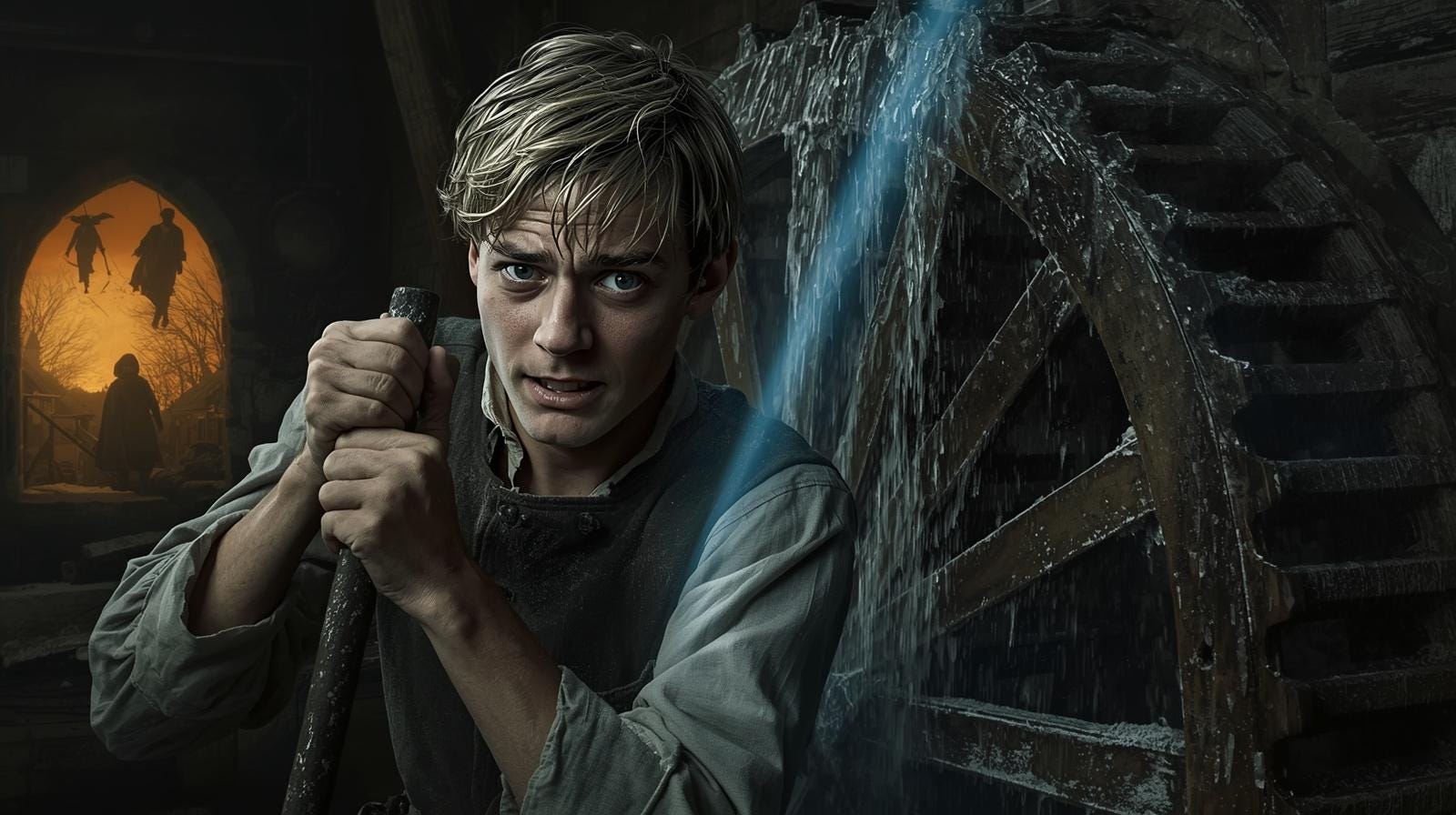
The grinding of the mill began before dawn, never entirely stopping—only stalling for the briefest shudder, a breathless pause before the teeth found their bite and the stone resumed its gnaw. Even in the apprentice’s sleep, the rhythm gnawed at his bones.
By full light, the wheel’s voice outshouted the crows and the church-bell, the constant drag and pulse rattling windows and vertebrae alike. The whole village wore the residue: flour dust drifting on air, clinging to the oil in men’s hair, the ridges of children’s nails, the hush of every cloth. A sniffle, a cough, a laugh—flour floated from mouths, caught in sunbeam flares above the millrace.
He’d read the marks of the mill in the faces around him. Age pressed early and deep into flesh here: the old women knotting at their looms, hunched double before forty, their knuckles like raveled dough. The men’s skin went slack and gray, hair faded to ash before their sons could walk unassisted.
Even the children, shoulders dusted with white, blinked with the slow, sedimented patience of the spent. Time did not pass here; it shed, flaked off in layers, leaving behind the shape of the vessel, emptied grain by grain.
The apprentice—he had not earned a name here, not yet—could not remember ever having been new. He supposed he must have come from some other village, somewhere notched farther up the river, but that memory was ground to meal, indistinguishable from the rest.
He bent over the splitting bench, skimming chaff from the hopper, hands moving in time with the wheel’s heartbeat. Every hour, he heard the stone grumble a little faster, as if the wheel drank more than water, as if it pulled from something deeper than the river’s crawl.
He began to watch the villagers as keenly as he watched the gears. Old Marja, who spat curses and chewed poppy, had lost the rest of her teeth in a week. The priest’s boy, once ruddy and loud, now shrank behind his father’s cassock, eyes soaked of color.
The apprentice marked the days by the gray in their hair, by the waxen sag at jaw and jowl. He worked the winch, tended the sluice, and tracked the creeping of age like a pest infestation. Every morning, he scoured his own reflection in the pail by the door, expecting some new slackness at his cheek, a dousing of his hair’s dusk-blond. He was never sure if he found it or if the expectation bred it.
The mill’s mechanism fascinated and repelled him. He’d crept into its guts to escape voices, crawling between long cogs and greasy wheels that shuddered in their iron nests. He learned to time his passage so gear teeth missed his knuckles by a breath, to duck the flecks of stone that spat from the grind.
Soon the wheel was in him, its logic assembling in his mind: headwater to drop ratio, paddle pitch, grain consumed per hour. There was beauty in it—motion begetting motion, each part necessary, each halt only prelude to the next bite. But the system was hungry, the cycle closing until every thought moved in circles, bent to feeding the turn.
He heard the grinding even when the sluice was closed, a phantom rasp in his skull, chipping through dreams. In the depths of the night, he sometimes wandered down to the millrace in his shirt, feet numbed by frost and silt.
The great wheel loomed black and patient, dripping like a jaw above the river. He would lean close and listen to the hush between the creaks, the soft hiss of water finding every gap. Once, in the hush, he heard a different sound—a thunk, wet and final, as if something had been caught and shredded in the wheel.
He peered into the race but saw only the whirl of river and the moon’s ripple, cold and endless. In the morning, the grain sacks seemed lighter, but no one else remarked it.
The memory of that thunk—viscera in the gear, maybe, a rat or a bird or a scrap of something important—refused to let go.
On the third morning after, the apprentice slid a wedge into the main gear and waited for the wheel’s protest. It came in a low groan, a grinding reluctance. He pressed harder, both hands on the worn haft. The teeth slipped, caught, then slipped again.
For a moment, the entire building seemed to resist—timbers creaking, floorboards trembling under his knees. The wheel did not want to stop. But he’d learned leverage from the stones, patience from the sluice, and he leaned his whole weight, breath locked in his chest, until the wedge sank and the river’s current spilled over the stilled paddles with a hiss, like an animal denied.
The silence stung. The hush was so sudden it pulsed in his ears. From inside the mill, he could hear the village draw an answering breath, a confusion in the stillness. The crows had resumed—or else they’d never stopped—their cawing, no longer drowned by the grind, now carrying clear and raw over the rooftops.
He circled the millworks, checking for the jam he’d imagined. Nothing: the gears were clean, the channel empty except for the usual silt and a single feather, black and sodden, pressed flat to the lintel. He flicked it into the water.
He hesitated, then did the unthinkable: he unseated the coupling and set the wheel to reverse.
The mechanism resisted at first against the full memory of the river, as if every drop of water for miles remembered only how to fall and pull—never how to climb, never how to give. But his arms sang with the effort, and after a long, shuddering second the iron gave a whimper and the teeth lurched backward, one notch at a time.
The wheel groaned. The building vibrated in his marrow. He felt the reverse in his throat, a dizzying, sucking pressure, as if the air itself had thickened, soured.
Outside, the village congealed. Crows hung snagged in air, wings frozen mid-flap. The river peeled from its banks, froth climbing the wheel’s paddles instead of falling. His hands trembled on the lever, veins knotting over bone as sweat slicked his lips with penny-metal taste. Each backward notch in the wheel sounded a protest, as if the wood remembered its own grain unmaking itself.
The village, seen through the warped glass of the millhouse window, jerked and stilled in uneven pulses. Men in the lane paused mid-stride, boots hovering above the mud, then jerked backward over their footprints. The priest’s boy’s sticks leapt to his arms, unbroken, his hair darkening by slow increments.
Old Marja’s back straightened, her face un-wrinkling with the waxy, alarming grace of a candle relit.
The apprentice’s own breath caught in his chest as he watched the wheel turn both forward and backward at once, the paddles slicing through water that simultaneously rose and fell.
The sun slid a thumb’s width back behind the hill; the light cooled, then blued, then vanished altogether. Windows shimmered with flour dust and laughter reversing course.
A baby’s cry un-cried itself, voice bubbling into silence. The wheel’s teeth gnashed and ground against themselves, wood splintering and healing in the same moment.
The apprentice’s ears filled with the impossible sound of water rushing up and down, of time’s hinges creaking open and closed, of the village’s collective breath drawn in and expelled at once—a roaring, sucking cacophony that pulled at his bones like the tide.
The Wheel That Kept Turning
On where this story came from
There is a particular quality to waiting that nobody talks about honestly. Not the anxious kind, where you’re checking your phone every four minutes and pacing the floor. The other kind. The long kind. The kind that settles over months, where you stop fighting it and just move through your days inside of it.
